



Four organs, four profiles
Each organ has its own composition. By combining the four you get a broader profile than with a single organ.
The whole animal
In traditional cuisines the whole animal was eaten: kidneys in the pan, braised heart, liver with onions. Today most people only eat muscle meat. This blend brings back four organs in a form you do not have to cook or taste.
Vitamin A and pregnancy
Because of the liver, the blend contains vitamin A. The Netherlands Nutrition Centre (Voedingscentrum) advises women who are pregnant or trying to conceive not to eat liver, and that advice applies here too. Also do not unknowingly combine the blend with cod liver oil or other sources of vitamin A.
Beef Organ Blend
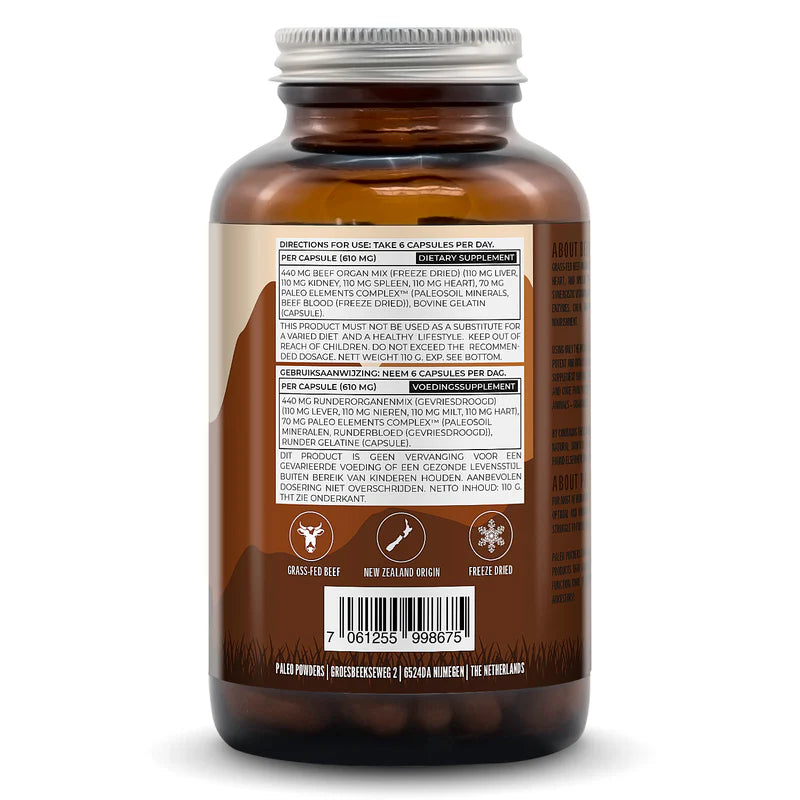
The Beef Organ Blend from Paleo Powders combines four different organs with our own Paleo Elements Complex. Each organ has its own composition, with organ-specific components such as peptides, purines, enzymes and CoQ10. Our organs come from grass-fed cattle. Take six capsules a day as part of a varied diet. That way you eat not only muscle meat but also organs, as used to be customary.
The Beef Organ Blend at a glance
A blend of heart, kidneys, liver, spleen and blood. Made exclusively from ingredients from pasture-raised cattle from New Zealand, kept in their natural habitat and grazing freely. Raw freeze-dried. With CoQ10 from the heart. With spleen and liver, as in traditional blood dishes. Contains the Paleo Elements Complex of mineral earth and blood. Guaranteed free from pesticides, herbicides, fillers, hormones and GMOs. 180 capsules of 510 mg each.
Eating well in modern times
In our modern times there always seems to be an abundance of food, yet organ meat, once a fixed part of the menu, has largely disappeared from our plates. Organs have a different composition from muscle meat. By eating organs again, we eat the way our ancestors did.
Nose-to-tail eating and its history
Nose-to-tail eating is an essential part of human history. From the very beginning until not so long ago, our ancestors always ate the whole animal, nose to tail. Why would you leave the most valuable parts behind? You still see this today among indigenous peoples: nothing is wasted, and the organs in particular are considered the most valuable part. What used to be intuition has to be learned again today. Until recently nose-to-tail eating seemed a thing of the past, but with growing interest it appears to be making a comeback. The wish to eat like our ancestors is shared by more and more people. Organs, glands and other animal parts connect us with that culinary heritage.
The four organs
Grass-fed liver: the best-known organ meat. Liver with onions was a weekly dish in the Netherlands for a long time. Grass-fed heart: heart naturally contains coenzyme Q10. Braised heart is a classic in many traditional cuisines. Grass-fed kidneys: kidneys in the pan are a traditional dish. Grass-fed spleen: traditionally eaten in blood sausage and pâté and used in sausages and pies in many cuisines.
Hunter-gatherers
Since the emergence of modern humans, we have mostly lived as hunter-gatherers. We evolved on the basis of a number of important factors that shaped our way of life: eating wild, seasonal and nose to tail. Exposure to the natural elements and the rhythms of nature, combined with a lot of physical activity. Darkness at night and sunlight on our skin and eyes during the day. Together these elements shaped the human way of life for centuries.
Mineral earth and beef blood
Because we want to make supplements that come close to real ancestral food, we have added our own Paleo Elements Complex to the organ blend. This addition consists of raw beef blood from New Zealand and European paleosoil, in small amounts, as in a real ancestral scenario.
Blood as food
Animal blood has always been part of the human diet, especially in prehistoric times. For modern hunter-gatherers such as the Maasai and Bodi tribes of Africa and the Inuit of the Arctic and Subarctic regions, blood from the livestock they herd or from wild animals is an important part of the diet. Blood contains red and white blood cells, platelets, immunoglobulins, peptides and enzymes. We only use blood from New Zealand pasture-raised cows.
Earth as food
Eating earth is as old as humanity itself. Edible earth has been eaten in many cultures since time immemorial. Geophagy, the deliberate eating of earth, has been documented in all parts of the world since antiquity. On the other hand, unintentionally eating earth was an unavoidable part of daily life in Palaeolithic times. Earth was consumed in varying small amounts via fresh plant food, hunted animals and via hands and tools.
Paleosoil, a distinctive ingredient
That also carried risks, such as exposure to pathogenic micro-organisms. We add our paleosoil out of that tradition, not for therapeutic or probiotic reasons. Paleosoil is 100% natural and clean and comes from aeolian sediment from the European ice age. The natural mix of minerals and trace elements in our paleosoil includes silicon, calcium, potassium, magnesium, sodium, phosphorus, copper, manganese, nickel and zinc.
Sustainable origin from New Zealand
We deliberately choose organs from pasture-raised cows, kept without hormones or antibiotics and with minimal commercial feed.
Origin and processing
Paleo Powders brings organ supplements of the highest quality to market. The freeze-dried organ powders chosen for our products come from grass-fed cattle from New Zealand or Europe. We do not use raw materials from animals from countries known for intensive livestock farming with frequent antibiotic use. On the contrary, the animals are kept with care for animal and environment, meaning the cattle live in their natural habitat, spend most of their time outdoors, are properly cared for and carefully monitored. You can see this in the quality of the meat and in the Paleo Powders organ supplements. Because the ingredients are raw freeze-dried, the composition of the organs is preserved. The supplements are composed and tested with the utmost care and therefore contain no pesticides, hormones or fillers.


