
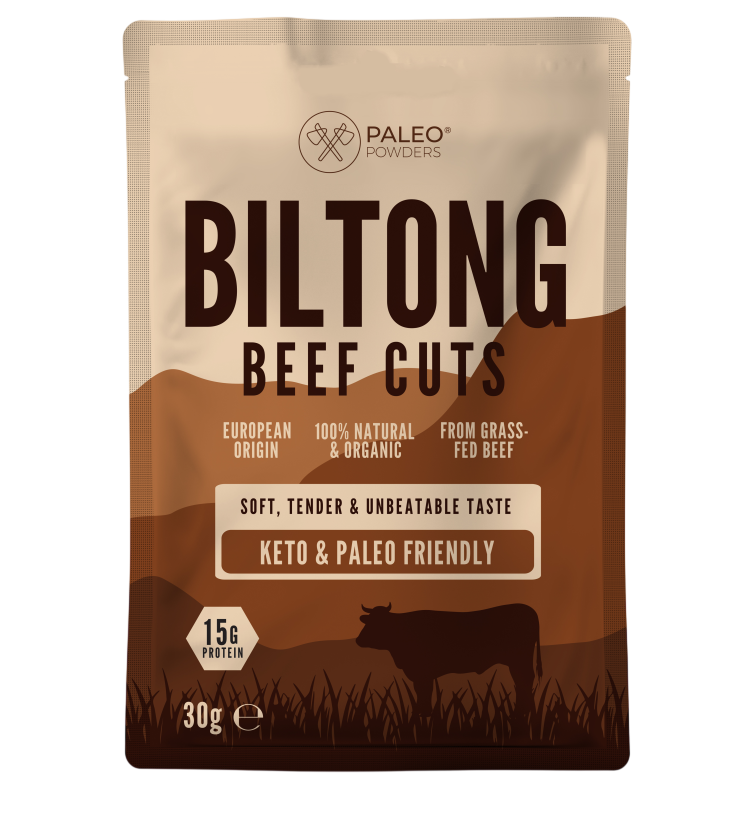
Biltong Beef Cuts - Organic - 30 grams
- Biltong protein snack
- Grass-fed beef from the Spanish Pyrenees
- Organic
- 30 grams
 Money back guarantee + €15.00
 Order before 10pm, delivered within 2 days!
 Free shipping above €75.00 (NL, BE, DE)
Grass-Fed Biltong
Biltong Beef Cuts from Paleo Powders are a nutritious and tasty protein snack with South African roots. Paleo Powders exclusively uses carefully selected grass-fed cattle from the Spanish Pyrenees. This biltong contains no added sweeteners, additives, or preservatives. It is also free from lactose and gluten.
Biltong: The Pioneers' Protein Snack
The origin of biltong dates back to the time of the Low Countries settlers who established themselves at the Cape of Good Hope (present-day Cape Town) in the 17th century. They brought with them traditional European methods of meat preservation, such as curing, seasoning, and drying.
Over time, these techniques were adapted to local conditions. Air-drying, for example, proved highly effective in the local warm, dry climate. Spices, including coriander and pepper, gradually found their way into the recipe.
The name "biltong" can be explained by this Dutch-African history: "bil" (rump or hindquarter of the animal) and "tong" (strip).
Although biltong is now eaten worldwide, its historical basis lies in the Dutch preservation traditions that further developed in South Africa. Biltong was a long-lasting and thus essential food source during long treks and later during the Great Trek: between 1835 and 1845, approximately 12,000 Dutch-speaking farmers (Voortrekkers, "pioneers") left the British Cape Colony and established their own independent Boer Republics.
Biltong vs. beef jerky
Biltong and beef jerky are both dried beef. However, the production process and the final taste differ significantly.
Biltong is traditionally made by first marinating thick strips of meat in vinegar, salt, and spices including coriander and black pepper, and then slowly air-drying them. This keeps the meat more tender, fuller in flavor, and often cut slightly thicker.
Beef jerky, originally American, is made from thinner slices of meat. These are often put in a sweeter marinade (with teriyaki or soy sauce, or sugar) and then dried at relatively high temperatures. As a result, jerky is generally tougher, drier, and sweeter; biltong is softer, more aromatic, and savorier.
Perfect protein snack
Today, biltong has found its way to athletes, outdoors enthusiasts, and anyone looking for a pure, protein-rich snack without unnecessary additives. Thanks to the traditional drying process, the meat becomes exceptionally tender and concentrated in flavor. Take it as a quick protein fix after a workout, use it during outdoor activities, or simply as a savory treat between meals – biltong combines nutrition and taste in every bite.
- Grass-fed beef from the Spanish Pyrenees
- Rich in zinc and iron
- Rich in vitamins A and B12
- High in protein but low in fat and calories: suitable for low-carb and keto diets
- No sweeteners or sugars
- No preservatives, colorings, or nitrites
- Gluten- and lactose-free
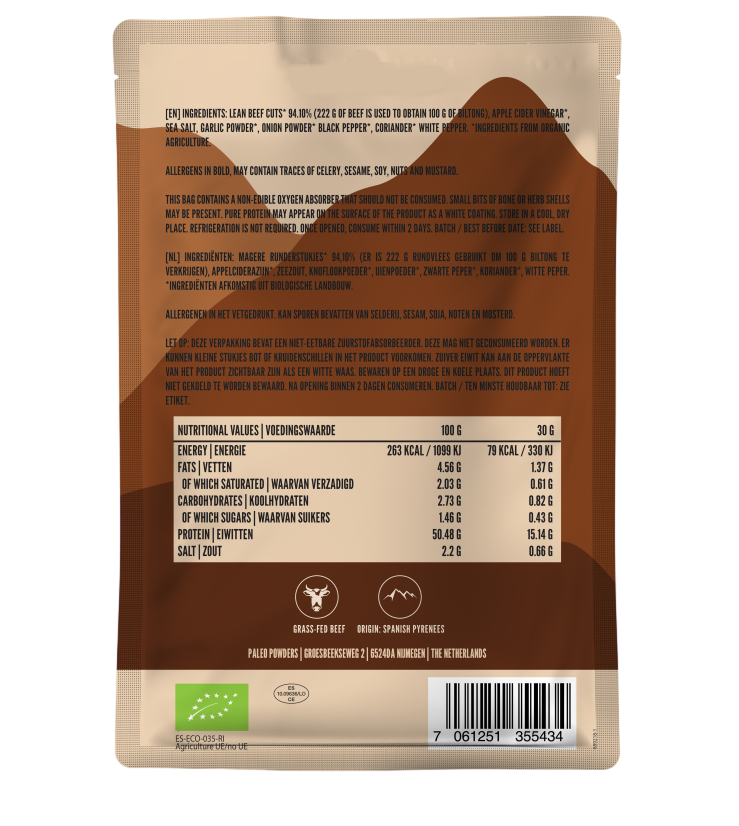
| Nutritional value | Per 100 g | Per 30 g |
|---|---|---|
| Energy | 263 kcal / 1009 kJ | 79 kcal / 330 kJ |
| Fats | 4.56 g | 1.37 g |
| of which saturated | 2.03 g | 0.61 g |
| Carbohydrates | 2.73 g | 0.82 g |
| of which sugars | 1.46 g | 0.43 g |
| Proteins | 50.48 g | 15.14 g |
| Salt | 2.2 g | 0.66 g |
Why Grass-Fed?
Grass-fed animals are raised without chemical agents, receive natural feed, and get all the exercise a grazing herd animal needs. Their meat therefore has a higher nutritional density. In general, it contains more protein, vitamins B2, E, and K2, beta-carotene (vitamin A precursor), more omega-3 fatty acids, and also conjugated linoleic acid (CLA). Various minerals (including zinc, iron, sodium, potassium, phosphorus) are also usually more abundant.
Choose options
Money back guarantee + €15.00
Order before 10pm, delivered within 2 days!
Free shipping above €75.00 (NL, BE, DE)