Collagen hydrolysate wild-caught fish, 500 g.

★★★★★ 5.0 · 5 reviews

Type I collagen from wild-caught fish from the North-East Atlantic Ocean, more than 95% protein. Neutral taste, dissolves quickly. Contains fish.

Why this product?

Type I collagen, from wild-caught fish

North-East Atlantic Ocean, FAO area 27

More than 95% protein, neutral taste

Tested per batch for heavy metals and microbiology

Contains fish, 20 grams per day

Regular price €39,95
Regular price Sale price €39,95
Sale Sold out
500 grams · 20 grams per day · €1.60 per day
Taxes included.
Quantity

In stock

Order before 22:00, processed the same day

Free shipping from €85.00 (NL, BE, DE)

Dutch customer service, free advice

View full details
Collagen Hydrolysate - Wild Caught Fish - 500 grams

Collagen hydrolysate wild-caught fish, 500 g.

Order before 22:00, processed the same day
Free shipping from €85.00
Money-back guarantee
€39,95
€1,59 per dose
Quantity
01 / The story

Collagen, from wild-caught fish.

01, The story
02, Form & figures
03, Ingredients & dosage
04, What we may claim
05, Quality & production
06, Frequently asked questions
Reading time · 6 min

Paleo Powders' fish collagen comes from wild-caught fish from the north-east of the Atlantic Ocean. It contains type I collagen, is more than 95% protein and tastes neutral. You take two scoops (20 grams) per day.

From the skin of the fish

Fish collagen is made from the skin and scales of fish, parts that are left over after filleting. Paleo Powders' collagen comes from wild-caught fish from FAO area 27, the north-eastern part of the Atlantic Ocean that stretches from the North Sea to the Barents Sea.

Type I collagen

Fish collagen consists almost entirely of type I, the collagen that is most common in skin, bones and tendons. It is cut by enzymes into peptides of approximately 3 kDa, so that it dissolves quickly and has no fishy taste.

Use

Mix two scoops, 20 grams, with 300 ml of water, juice, milk, a smoothie or a shake, or stir it into coffee, soup or yoghurt. A 500 gram jar lasts 25 days. Contains fish.

What is Collagen Hydrolysate?

Collagen hydrolysate is a specially processed protein found in animal connective tissues such as skin, tendons and cartilage. This type of collagen has been broken down into smaller peptides by enzymatic hydrolysis, making it faster and more easily absorbed by the body. Because collagen is one of the most abundant proteins in the body, it plays an important role in various biological processes.

Collagen in Nature

The name collagen is derived from the Greek word colla, which means glue. This refers to collagen's natural function as a structural glue in the body. It provides strength and flexibility to tissues. Naturally, collagen is found in various animal sources such as fish, beef and poultry. Fish collagen is becoming increasingly popular because of its high purity and easy digestibility.

Why Choose Collagen from Wild Fish?

Collagen hydrolysate from wild fish has a number of specific advantages over other sources. Wild fish grows up in a natural environment without antibiotics or artificial nutrition. This results in a purer product with a balanced amino acid composition. In addition, fish collagen is particularly soluble and has a neutral taste. Sourced from sustainably wild-caught fish from European waters. Contains type I collagen, an important structural building block of the body. Neutral taste, ideal for drinks and meals. Over 95% protein per dose. Quickly soluble and easily digestible. No added sugars, preservatives or artificial substances. 500 grams per jar.

How Do You Use Collagen Hydrolysate?

Collagen hydrolysate is easy to mix into both cold and hot beverages, such as tea, coffee or smoothies. Due to its neutral taste and fine structure, it dissolves well without forming lumps. You can also incorporate it into dishes such as soups or yogurt.

Important Amino Acids in Collagen

Collagen hydrolysate is rich in specific amino acids such as glycine, proline and hydroxyproline. These amino acids are found in relatively low amounts in other protein sources, but play essential roles in building and supporting structural proteins. For example, glycine is involved in the synthesis of DNA and enzymes, while proline is an important building block for collagen-rich tissues.

Suitable for Various Dietary Patterns

Collagen hydrolysate fits well into a variety of dietary patterns, including the keto and paleo diets. Because it contains virtually no carbohydrates and fats, it is an excellent source of protein without unnecessary additives. It is also a valuable option for people striving for a natural and pure diet.

European Production and Sustainability

Collagen hydrolysate is produced according to strict European quality standards. Wild fish is caught in the Atlantic Ocean (FAO 27) and processed into collagen peptides in certified facilities. This guarantees a high-quality product that meets environmentally friendly and sustainable guidelines.

The Production Process

Collagen hydrolysate is produced via enzymatic hydrolysis. This process breaks down long collagen molecules into smaller peptides with a molecular weight of about 3 kDa. This allows the amino acids to be absorbed faster and effectively assimilated by the body.

Purity and Quality

Each batch of collagen hydrolysate is extensively tested by independent laboratories. This involves checking for heavy metals, microbial activity and other possible contaminants. This ensures that the final product is safe and pure.

Differences Between Collagen Sources

There are a variety of collagen sources, each with their own characteristics. Fish collagen has a neutral taste, fast absorption, type I collagen and 95% protein. Bone broth has a mild taste, normal absorption, type I to V collagen and 98% protein. Kefir whey has a creamy taste, fast absorption, no collagen and 90% protein.

Historical Uses of Collagen

Collagen was consumed for centuries through bone broth and cartilage-rich parts of animals. This diet provided essential building blocks that are often lacking in modern diets today. The use of collagen supplements can easily supplement this intake.

Collagen and Hydration

Collagen molecules naturally contain water. Proper hydration helps support the properties of collagen and contributes to the transport of nutrients in the body. Drinking enough water in conjunction with collagen can help ensure effective absorption.

02 / Form & figures

Figures from the label.

As stated by Paleo Powders.

95%+
Protein
Per serving.
3 kDa
Peptides
Cut by enzymes.
FAO 27
Fishing area
North-East Atlantic Ocean.
25
Servings per jar
500 grams.
Ingredients and use

One ingredient. Two scoops per day.

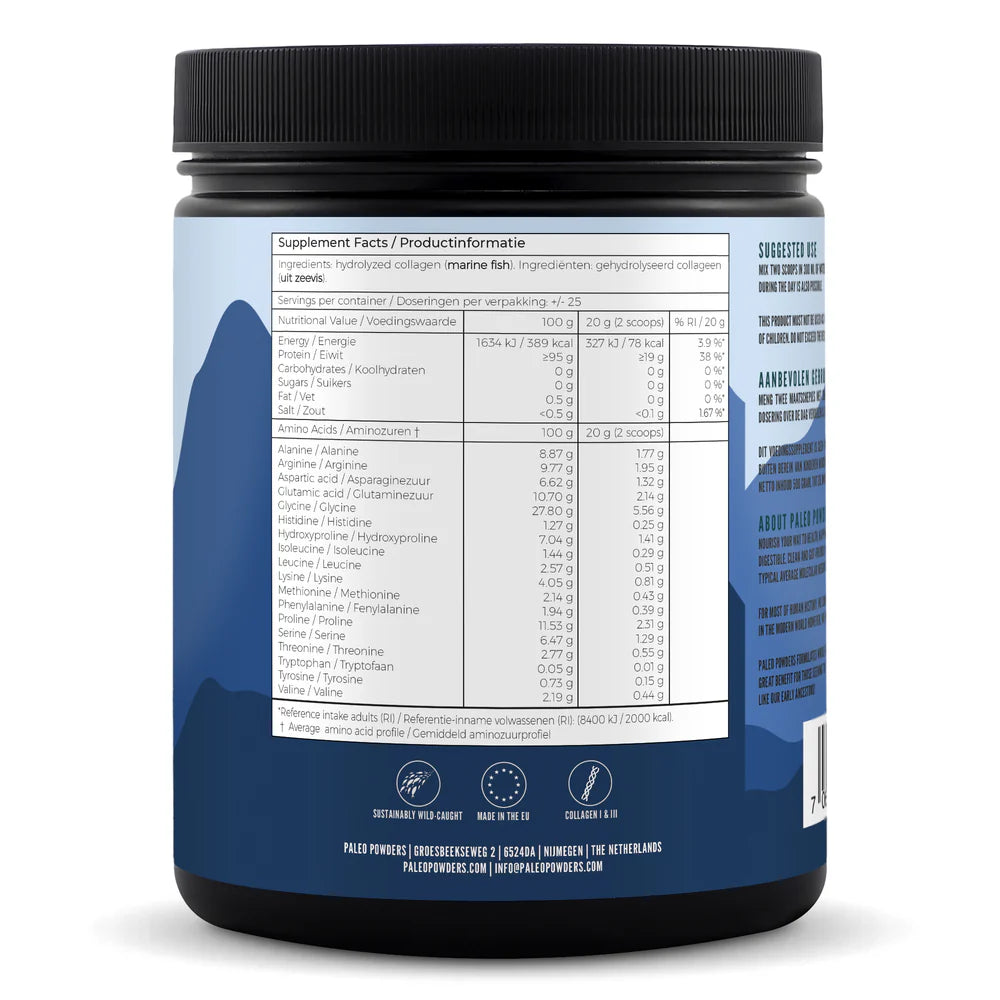
Per serving (20 grams) Amount %RI* Notes
Fish collagen hydrolysate 20 g* Type I, wild-caught, FAO 27
Of which protein More than 19 g* More than 95%
Peptide size Approx. 3 kDa- Enzymatic hydrolysis

* no reference intake established · no other ingredients · contains fish · no added sugars or preservatives · dosage: 2 scoops (20 grams) in 300 ml of liquid · net contents 500 grams

Product information

How to use it. And everything on the label.

How to use

  1. 1

    Mix two scoops (20 g) with 300 ml of water, juice, milk, smoothie or shake.

  2. 2

    It is also possible to divide the dosage over the day.

Contents
500 grams
Allergens
Fish
Other ingredients
-
Storage
Store in a cool, dry and dark place.
Do not exceed the recommended daily dose.
Food supplements should not be used as a substitute for a varied and balanced diet and a healthy lifestyle.
Keep out of the reach of young children.
* RI = reference intake according to European standards.

Reviews · 5.0 / 5 5

What we may claim

EFSA claims for collagen.

Framework
EU 432/2012
EFSA register
Subject
Collagen
(Paleo Powders)

In Europe, we may only make health claims about food supplements that have been assessed and authorised by the EFSA and are listed in the official EU register.

No health claims have been authorised in Europe for collagen and collagen peptides, not even for skin, hair or joints. That is why we make no claim for this product.

No authorised claims
EU register
Regulation 1924/2006

There is no authorised health claim for collagen.

On this page you can read what it contains, where it comes from and how to use it. What is said about this does not constitute authorised health claims.

Framework: Regulation (EC) No 1924/2006 and Regulation (EU) No 432/2012.

Professionally reviewed

Read and checked by a fellow professional.

Diederik Jansen

Independent researcher · editorial review

The content of this page has been checked for factual accuracy, from the composition to compliance with the European rules on health claims. Contains fish; not suitable for people with a fish allergy. Collagen is not a complete protein and is a supplement to, not a replacement for, other protein sources.

The content of this page has been checked for factual accuracy, from the composition to compliance with the European rules on health claims. Contains fish; not suitable for people with a fish allergy. Collagen is not a complete protein and is a supplement to, not a replacement for, other protein sources.

Curator's note
Collagen from the Atlantic Ocean, without a fishy taste.
Selected by Ergomax

For those who do not eat beef, or prefer fish: this collagen comes from wild-caught fish from the north-east of the Atlantic Ocean. It is almost pure type I collagen and tastes neutral.

Contains fish. Two scoops per day.

About the brand

Paleo Powders, briefly explained.

Paleo Powders

Traditional nutrition, in a modern form.

Paleo Powders brings back foods that used to be a matter of course on the menu, such as organ meat, bone broth, collagen and fermented dairy. The brand works with grass-fed cattle and wild-caught fish, and chooses pure products without fillers.

All products from Paleo Powders
Quality and production

Wild-caught fish, tested for heavy metals.

Paleo Powders' fish collagen comes from wild-caught fish from the north-east of the Atlantic Ocean. Every batch is tested in an independent laboratory for heavy metals and microbiology.

Origin 01
Atlantic Ocean
Wild-caught, FAO 27
Processing 02
Enzymatic
Hydrolysed
Testing 03
Heavy metals
Tested per batch
Composition 04
Sugar-free
Keto-friendly
08 / Frequently asked questions

What you still wanted to know.

Paleo Powders recommends two scoops of fish collagen per day, 20 grams in total, mixed with 300 ml of water, juice, milk, a smoothie or a shake. It also dissolves in coffee, tea or soup. A 500 gram jar lasts 25 days.

No. Because of the enzymatic hydrolysis into small peptides, it is virtually tasteless and odourless. It does contain fish, so it is not suitable for people with a fish allergy.

Paleo Powders' beef collagen comes from the bones of grass-fed European cattle and contains type I and III collagen. The fish collagen comes from wild-caught fish from the Atlantic Ocean and consists almost entirely of type I. Both are more than 95% protein. Fish collagen is an alternative for people who do not eat beef; if you have a fish allergy, beef collagen is the choice.

Paleo Powders' fish collagen comes from wild-caught fish from FAO area 27, the north-eastern part of the Atlantic Ocean that stretches from the North Sea to the Barents Sea. It is enzymatically hydrolysed in certified European facilities and every batch is tested by independent laboratories for heavy metals and microbiology.

Collagen hydrolysate is collagen that has been enzymatically cut into small peptides; it dissolves quickly and tastes neutral. Bone broth is cooked bones, which besides collagen also contain gelatine, glucosamine, chondroitin and hyaluronic acid, and has a mild, savoury flavour.

No. Collagen is rich in glycine, proline and hydroxyproline, but lacks the essential amino acid tryptophan. It complements a diet with a lot of lean muscle meat, which contains little glycine, but does not replace other protein sources such as meat, fish, eggs or whey protein.

Can't find your question? We're happy to help.
Call customer service →