



Weston A. Price among the Aboriginal people
In the 1930s, the American dentist and nutrition researcher Weston A. Price travelled the world to study the diets of peoples living traditionally. He wrote of the Aboriginal people that they were free from chronic disease and strong in body and mind. He also saw that the women had healthy children generation after generation. Price calculated that their diet contained at least ten times as many fat-soluble vitamins as the average American diet of his time. He named the fat of marsupials and emus as one of their most valued food sources.
Four families of fatty acids in one oil
Some 60 to 70 percent of emu oil consists of unsaturated fatty acids. These include omega 3 and 6, the essential fatty acids that the body cannot make itself, but also omega 7 and 9. The most important are oleic acid, linoleic acid and alpha-linolenic acid. The combination of these fatty acids gives the oil a unique effect. Oleic acid, linoleic acid and alpha-linolenic acid are considered proven to contribute to normal blood cholesterol levels. The oil is also rich in antioxidants and naturally contains the fat-soluble vitamins A, D3 and E and vitamin K2 in the form MK-4. This form occurs mainly in animal fat. Vitamin A nourishes the skin, is good for eyesight and supports the immune system, and vitamin E helps protect healthy body cells. Vitamin K supports blood clotting and the bones, and vitamin D is important for the calcium level in the blood, is good for the skeleton, the muscles and the process of cell division and also supports the immune system. In his work, Price described a fat-soluble substance he called Activator X, which he found again and again in the diets of traditional peoples. Later researchers point to vitamin K2 as the most likely candidate.
A ratite with a reserve layer
Like the ostrich, the emu belongs to the ratites. It is smaller and lighter than its African relative and still reaches a speed of around 50 kilometres per hour. On its back it carries a layer of fat full of nutrients, which allows it to go without food or water for a long time in the wild. The emu is found only in Australia and, after the ostrich, is the largest living bird in the world. The oil is obtained from its fat layer. The farmers Walkabout works with received the knowledge to refine the fat directly from an Aboriginal elder.
Unprocessed, as it comes from the animal
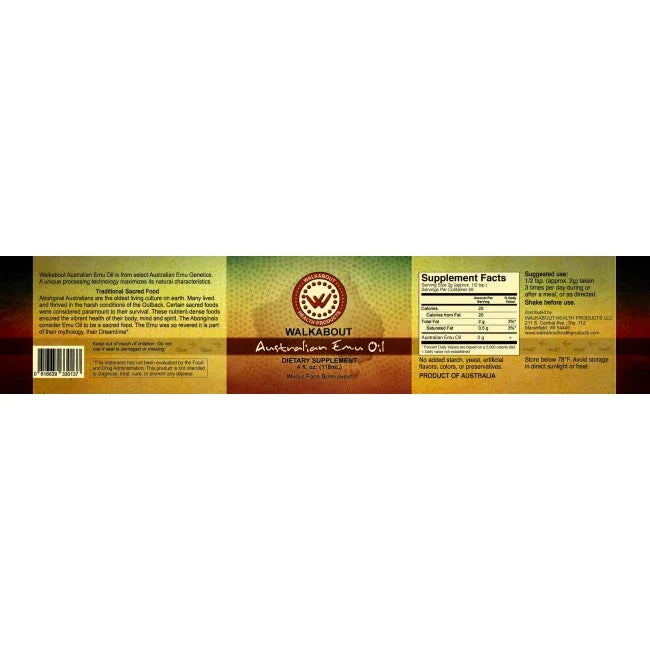
Walkabout emu oil is of superior quality. It comes from emus with a pure genetic pedigree. Much of the emu oil on the market is heavily refined. In the process, the smell, colour and some of the accompanying substances are removed from the oil. Walkabout opts for as little processing as possible, so that the composition stays close to that of the oil from wild emus that Aboriginal people have traditionally used. Thanks to this care, the oil also has a high biological activity. The emus roam freely in spacious pastures and receive no vaccinations, antibiotics or growth hormones. No pesticides are used on the farms either.
A powerful combination
Rosita Extra Virgin Cod Liver Oil and Walkabout Emu Oil make an excellent combination. The vitamin and fatty acid profiles are perfectly matched, creating a broad and complex range of nutrients when these two products are combined. Both natural oils are pure in composition and are rich in, among other things, natural vitamins A and D3 and a variety of omega fatty acids.
About Walkabout
It is the mission of the Australian brand Walkabout to inform people about the special properties and benefits of natural emu oil and to help them achieve a better quality of life through their diet. Walkabout emu oil is a particularly rich source of vitamin K2 (MK4), as well as other vitamins and omega fatty acids. Walkabout stays as close to the origin as possible by processing the product minimally. In addition, Walkabout works with specially selected, animal-friendly Australian emu farms.


