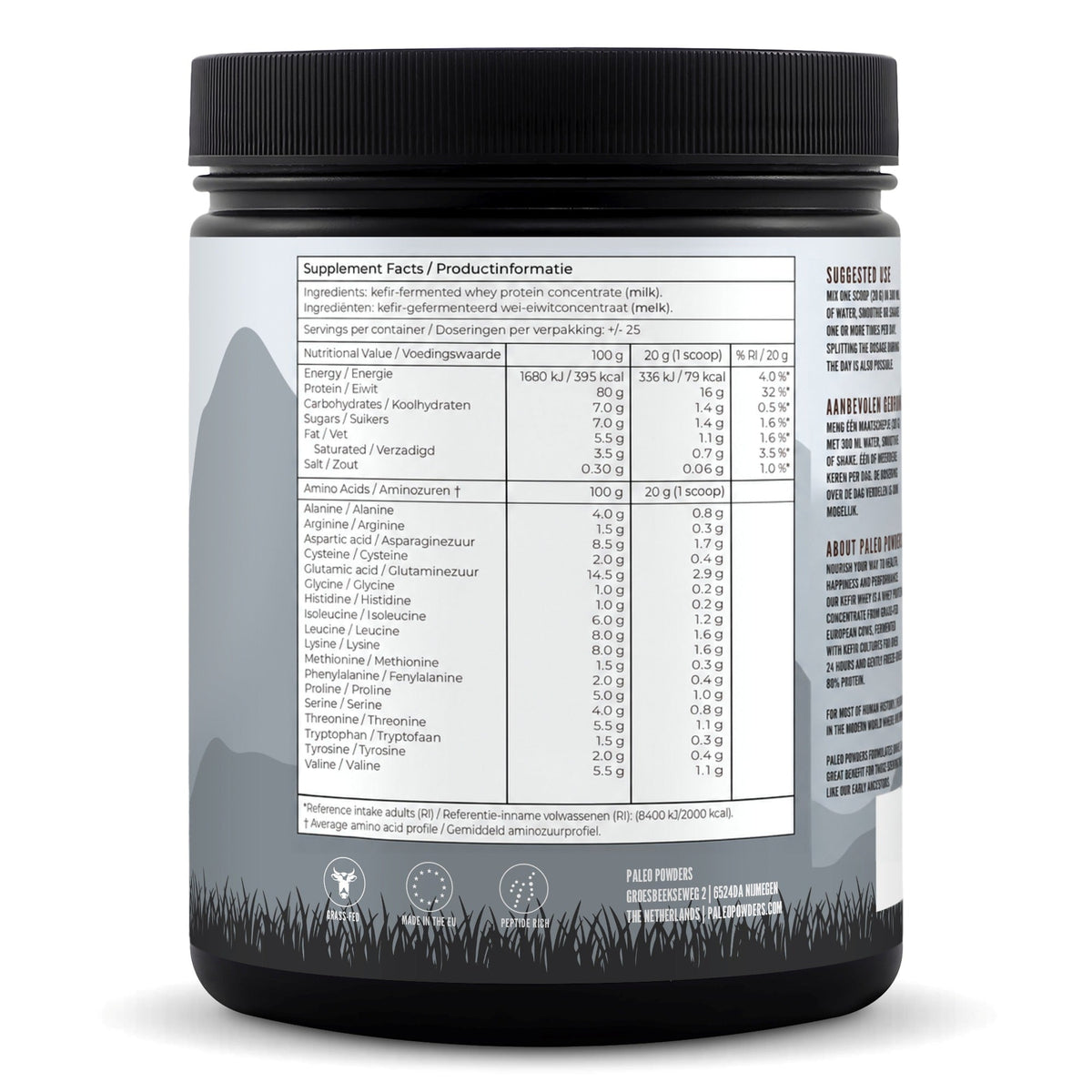
Kefir whey fermented protein, 500 g.

Whey protein concentrate from grass-fed European cows, fermented with kefir cultures for over 24 hours and then freeze-dried. Protein contributes to a growth in muscle mass. Contains milk.

Why this product?

Protein contributes to a growth in muscle mass, 80% protein

Fermented with kefir cultures for over 24 hours, then freeze-dried

Low in lactose, 1.4 grams of sugars per serving

Whey from European grass-fed cows, without grain or soya feed

Contains milk, no sweeteners or flavourings

Regular price €69,95
Regular price Sale price €69,95
Sale Sold out
500 grams · 20 grams per serving · €2.80 per serving
Taxes included.
Quantity

In stock

Order before 22:00, processed the same day

Free shipping from €85.00 (NL, BE, DE)

Dutch customer service, free advice

View full details
Kefir Whey - Fermented Protein Powder - 500 grams

Kefir whey fermented protein, 500 g.

Order before 22:00, processed the same day
Free shipping from €85.00
Money-back guarantee
€69,95
€2,79 per serving
Quantity
01 / The story

Whey protein, fermented with kefir.

01, The story
02, Form & figures
03, Ingredients & dosage
04, What we may claim
05, Quality & production
06, Frequently asked questions
Reading time · 6 min

Kefir Whey from Paleo Powders is whey protein concentrate from European grass-fed pasture cows, fermented with kefir cultures for over 24 hours and then freeze-dried. Along the way, part of the protein is pre-digested into small peptides and most of the lactose is converted. Protein contributes to a growth in muscle mass.

Kefir, the king of fermentation

Kefir comes from the Caucasus, where it has been made for centuries with kefir grains: small, cauliflower-like clusters of lactic acid bacteria and yeasts. According to tradition, the grains were passed down there as family heirlooms. Paleo Powders applies that principle to whey, the protein that is left over when cheese is made.

Over 24 hours of fermentation

Paleo Powders ferments the whey protein concentrate with kefir cultures for over 24 hours. During that time, the cultures convert most of the lactose and cut part of the whey proteins into smaller pieces, such as di- and tripeptides. The kefir whey is then freeze-dried, without high temperatures. What remains is a light protein powder with a mild, fresh taste.

Use

Mix one scoop, 20 grams, with 300 ml of water, juice, a smoothie or a shake. A 500-gram jar provides 25 servings. The powder contains cow's milk.

What's in a scoop

Paleo Powders uses whey protein concentrate. The powder is 80% protein and naturally contains a small amount of milk fat and milk sugar. A 20-gram scoop provides 79 kcal, 16 grams of protein, 1.4 grams of carbohydrates (of which sugars) and 1.1 grams of fat. Whey protein is a complete protein: it contains all the essential amino acids.

Made in the Netherlands, in small batches

The fermentation takes place in the Netherlands, in small batches. No sweeteners, flavourings or other additives go in: the label lists a single ingredient, kefir-fermented whey protein concentrate (cow's milk).

Grass-fed European pasture cows

The whey comes from European cows that graze outdoors. In winter, when there is little fresh grass and the cows are housed, they are fed silage. Grains, maize and soya are not used as feed, and concentrates only when really necessary.

Fermented, and therefore paleo

In the strictest form of the paleo diet, dairy is off the menu. Fermented dairy is a different story: fermentation is one of the oldest ways of processing food, and during fermentation most of the lactose is converted. That is why Kefir Whey fits into a paleo way of eating.

Light and easy to mix

Kefir Whey has a mild taste and dissolves easily in water, juice, a smoothie or a shake. With 1.4 grams of carbohydrates per serving, it also fits into a low-carb diet.

Kefir Whey alongside collagen and bone broth

Whey protein is a complete protein with all the essential amino acids. Per 100 grams, Kefir Whey contains 19.5 grams of the branched-chain amino acids leucine, isoleucine and valine, and 1.0 gram of glycine. Collagen and bone broth consist mainly of collagen protein, which is rich in glycine and hydroxyproline but is not a complete protein. So they complement each other well.

02 / Form & figures

Figures from the label.

As stated by Paleo Powders.

80%
Protein
16 grams per 20-gram scoop.
24+ hrs
Fermentation
With kefir cultures, then freeze-dried.
19.5 g
BCAAs
Leucine, isoleucine and valine per 100 grams.
25
Servings per jar
500 grams, 1 scoop (20 grams) per serving.
Ingredients and use

Whey and kefir. Nothing else.

Per serving (20 grams) Amount %RI* Notes
Kefir-fermented whey protein concentrate 20 g* Cow's milk from European grass-fed cows
Energy 336 kJ / 79 kcal4% Per 100 g: 1,680 kJ / 395 kcal
Protein 16 g32% Per 100 g: 80 g
Carbohydrates 1.4 g<1% Of which sugars 1.4 g (2% RI)
Fat 1.1 g2% Of which saturates 0.7 g (4% RI)

* no reference intake established · RI = reference intake of an average adult (8,400 kJ / 2,000 kcal) · contains cow's milk · no sweeteners or flavourings · dosage: 1 scoop (20 grams) in 300 ml of liquid · net contents 500 grams

Product information

How to use it. And everything on the label.

How to use

Mix 1 scoop (20 g) with 300 ml of water, juice, smoothie or shake.

Contents
500 grams
Allergens
Milk
Other ingredients
-
Storage
Store in a cool, dry and dark place.

Amino acid profileaverage per 100 g

  • Alanine4.0%
  • Arginine1.5%
  • Aspartic acid8.5%
  • Cysteine2.0%
  • Glutamic acid14.5%
  • Glycine1.0%
  • Histidine1.0%
  • Isoleucine6.0%
  • Leucine8.0%
  • Lysine8.0%
  • Methionine1.5%
  • Phenylalanine2.0%
  • Proline5.0%
  • Serine4.0%
  • Threonine5.5%
  • Tryptophan1.5%
  • Tyrosine2.0%
  • Valine5.5%
Do not exceed the recommended daily dose.
Food supplements should not be used as a substitute for a varied and balanced diet and a healthy lifestyle.
Keep out of the reach of young children.
* RI = reference intake according to European standards.

Reviews

What we may claim

EFSA claims for protein.

Framework
EU 432/2012
EFSA register
Subject
Protein
(Paleo Powders)

In Europe, we may only make health claims about food supplements that have been assessed and authorised by the EFSA and are listed in the official EU register.

The protein claims apply to foods that are at least a source of protein. This product consists of 80% protein. There is no authorised claim for the kefir fermentation or the peptides.

Protein contributes to a growth in muscle mass.

EFSA · AUTHORISED HEALTH CLAIM

Protein contributes to the maintenance of muscle mass.

EFSA · AUTHORISED HEALTH CLAIM

Protein contributes to the maintenance of normal bones.

EFSA · AUTHORISED HEALTH CLAIM
Professionally reviewed

Read and checked by a fellow professional.

Diederik Jansen

Independent researcher · editorial review

The content of this page has been checked for factual accuracy, from the composition to compliance with the European rules on health claims. Contains milk; not suitable if you have a cow's milk allergy. Due to fermentation, the lactose has largely been broken down.

The content of this page has been checked for factual accuracy, from the composition to compliance with the European rules on health claims. Contains milk; not suitable if you have a cow's milk allergy. Due to fermentation, the lactose has largely been broken down.

Curator's note
Whey protein, partly pre-digested by kefir cultures.
Selected by Ergomax

Paleo Powders ferments whey protein concentrate from European grass-fed cows with kefir cultures for over 24 hours, then freeze-dries it without high temperatures. As a result, part of the protein has already been cut into small peptides and most of the lactose has been converted.

A light, pure protein powder for anyone who finds regular whey harder to tolerate. One ingredient, no additives. It contains milk.

About the brand

Paleo Powders, briefly explained.

Paleo Powders

Traditional nutrition, in a modern form.

Paleo Powders brings back foods that used to be a matter of course on the menu, such as organ meat, bone broth, collagen and fermented dairy. The brand works with grass-fed cattle and wild-caught fish, and chooses pure products without fillers.

All products from Paleo Powders
Quality and production

Pasture milk, slowly fermented.

The whey comes from European grass-fed pasture cows. After over 24 hours of fermentation with kefir cultures, the powder is freeze-dried in the Netherlands, without high temperatures. No sweeteners or flavourings go in.

Origin 01
Pasture cows
Grass-fed, Europe
Fermentation 02
Over 24 hours
With kefir cultures
Processing 03
Freeze-dried
Without high temperatures
Composition 04
80% protein
Low in lactose
08 / Frequently asked questions

What you still wanted to know.

Paleo Powders recommends one scoop of Kefir Whey, 20 grams, mixed with 300 ml of water, juice, a smoothie or a shake. Because the powder is 80% protein, one serving provides 16 grams of protein. A 500-gram jar provides 25 servings.

Kefir Whey from Paleo Powders is whey protein concentrate that has been fermented with kefir cultures for over 24 hours and then freeze-dried. During fermentation, part of the protein is cut into di- and tripeptides and most of the lactose is converted. The whey comes from grass-fed European pasture cows, and no sweeteners or flavourings are added.

During the fermentation of over 24 hours, the kefir cultures convert most of the lactose, so Kefir Whey contains little lactose. Many people with lactose intolerance tolerate it well; if your intolerance is severe, start with a small amount. Kefir Whey is not suitable if you have a cow's milk allergy, because it contains milk protein.

Paleo Powders ferments the whey protein concentrate with kefir cultures for over 24 hours, in small batches in the Netherlands. The kefir whey is then freeze-dried, without high temperatures. No sweeteners, flavourings or other additives are added.

Whey protein is a complete protein containing all the essential amino acids; per 100 grams, Kefir Whey contains 19.5 grams of the branched-chain amino acids leucine, isoleucine and valine. Collagen is not a complete protein, but it is rich in glycine (21.6%) and hydroxyproline, which are barely present in whey: Kefir Whey contains 1.0 gram of glycine per 100 grams. So the two complement each other.

Can't find your question? We're happy to help.
Call customer service →