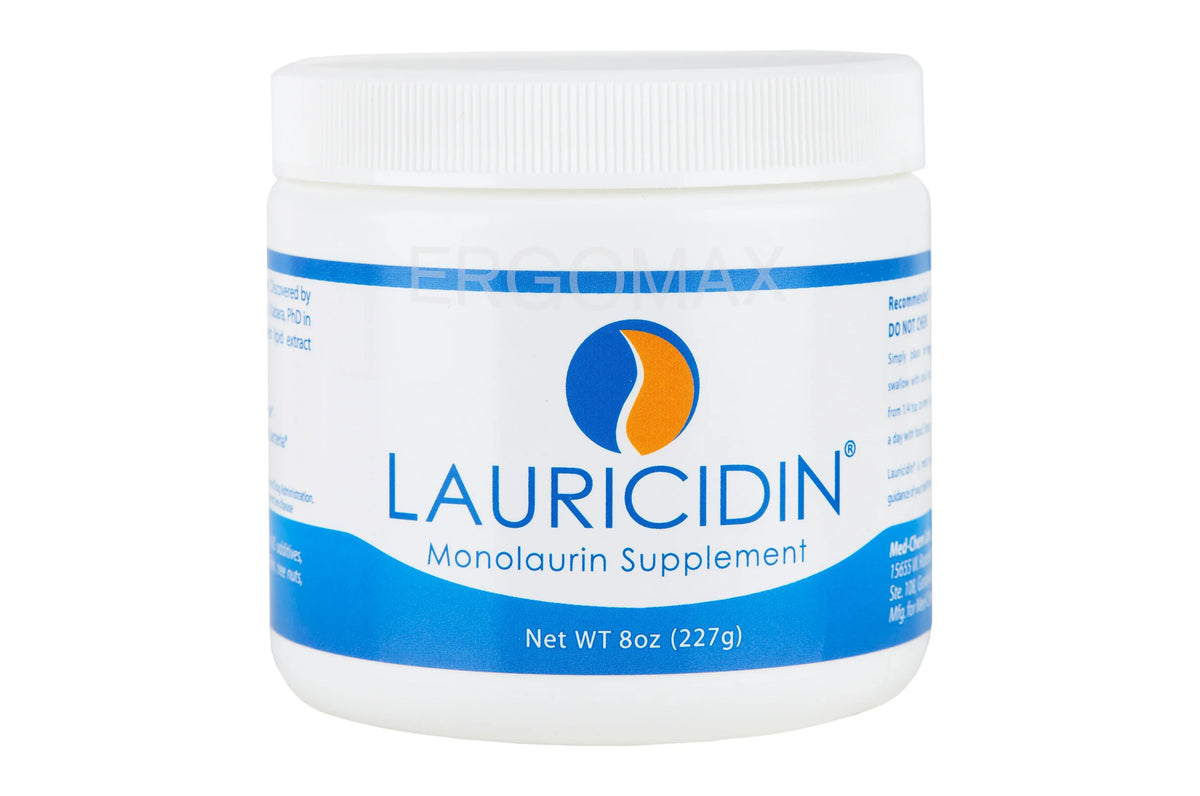
Lauricidin monolaurin.

★★★★★ 5.0 · 1 reviews

Pure monolaurin from lauric acid from coconut oil and glycerol, 3000 mg per scoop. Small pellets to swallow, without excipients.

Why this product?

3000 mg monolaurin per scoop, from lauric acid from coconut oil and glycerol

The first monolaurin supplement, developed by Professor Jon Kabara

No excipients or fillers, just pure monolaurin

Small pellets to swallow, do not chew and do not dissolve

Vegan and free from gluten, soy, dairy and corn, in a 227 gram jar

Regular price €45,95
Regular price Sale price €45,95
Sale Sold out
227 grams · 1 scoop per dose · €0.61 per scoop
Taxes included.
Quantity

In stock

Order before 22:00, processed the same day

Free shipping from €85.00 (NL, BE, DE)

Dutch customer service, free advice

View full details
Lauricidin - Monolaurin Supplement - 227 grams

Lauricidin monolaurin.

Order before 22:00, processed the same day
Free shipping from €85.00
Money-back guarantee
€45,95
€0,61 per serving
Quantity
01 / The story

Monolaurin from coconut, in small pellets.

01, The story
02, Form & figures
03, Ingredients & dosage
04, What we may claim
05, Quality & production
06, Frequently asked questions
Reading time · 6 min

Lauricidin is pure monolaurin, made from lauric acid from coconut oil and glycerol. Monolaurin occurs naturally in breast milk and coconut oil, among other things. You swallow the pellets whole, with or after a meal, and you build up the dose gradually over a few weeks.

What monolaurin is

Monolaurin is a monoglyceride: one molecule of lauric acid, a fatty acid with twelve carbon atoms, bound to glycerol. Lauric acid is the main fatty acid in coconut oil. One scoop of Lauricidin contains 3000 mg monolaurin.

Discovered by Jon Kabara

In the sixties, Professor Jon Kabara researched lauric acid and monolaurin at the University of Detroit, including monolaurin in breast milk. In 1966 he founded Med-Chem Labs and brought Lauricidin to market, the first supplement with monolaurin. It has now been in use for more than fifty years.

Swallow, do not chew

You swallow the pellets whole. Put them in your mouth with or after a meal and wash them down with cold water or juice. Do not chew them and do not dissolve them in water, as they will then melt. Start with a quarter scoop and build up over a few weeks.

Monolaurin: Lauricidin from Med-Chem Labs

Lauricidin monolaurin contains the pure plant-based monolaurin extract Lauricidin. Lauricidin is made from one part lauric acid and one part glycerol. The lauric acid comes from pure coconut oil. Monolaurin is the natural fatty acid lauric acid with 12 carbon atoms and monoglyceride, the glycerol ester of lauric acid. The effect of Lauricidin is very well documented and the supplement fits perfectly into a conscious, healthy and vital lifestyle. Monolaurin occurs naturally in breast milk, coconut oil, saw palmetto and the bitter melon fruit, among other things.

Benefits

Lauricidin contains the natural fatty acid monolaurin, 3000 mg per dose. It is safe for daily use, completely plant-based and suitable for vegetarians and vegans. It contains no excipients, fillers, toxins or coconut allergens, and no wheat, gluten, soy, dairy or corn.

Discovered in 1960 and proven effective

Monolaurin was discovered in 1960 by Dr Jon Kabara during his work at the Department of Chemistry of the University of Detroit. Together with his students, he researched lauric acid and monolaurin and they mapped out its particular beneficial properties. Not long afterwards, Med-Chem Laboratories was founded and production of the first monolaurin supplement, Lauricidin, became a reality. The supplement has now been used with great success by professionals in the health field for more than 50 years.

Safety and use

Lauricidin is safe to use for children (at a lower dose) and adults. The American Food and Drug Administration (FDA) has given it GRAS status (Generally Recognized As Safe). Lauricidin is therefore non-toxic and completely natural. However, when using Lauricidin, a temporary so-called Herxheimer reaction may occasionally occur. This is a favourable reaction, but it may be accompanied by flu symptoms, allergy complaints, headache, muscle pain and skin problems. Building up Lauricidin gradually over a number of weeks and drinking enough water can reduce or prevent this reaction.

Combines well with other supplements

Lauricidin can safely be used by people with a coconut allergy because it is a purified extract of coconut oil. Use for 3 to 6 months usually gives the best results. You can use Lauricidin daily, just like a multivitamin. Lauricidin combines well with other food supplements and with probiotics.

How to use

With or after a meal, put the pellets in your mouth and swallow them whole. Wash them down with cold water or juice. Do not chew the pellets. Do not dissolve the pellets or mix them into cold or warm water, as the pellets will then melt. Pay close attention to how your body reacts and adjust the dose accordingly: some people need a little more and others a little less. For adults: start with a low dose, a quarter scoop or less, 2 to 3 times a day with meals, for 1 week. Slowly build up the dose to half a scoop 2 to 3 times a day, up to the maintenance dose of 1 scoop 2 to 3 times a day. For children aged 3 to 10: start with a low dose, 3 pellets 2 to 3 times a day with meals, for 1 week. Build up the dose slowly.

About Med-Chem Labs

Med-Chem Labs was founded in 1966 by Professor Dr Jon Kabara. In the sixties, Kabara discovered the beneficial effects of monolaurin in breast milk. This led to the creation of Med-Chem Labs and the launch of the food supplement Lauricidin, based on monolaurin, as a brand and product. Lauricidin is pure monolaurin and is made from one part lauric acid and one part glycerol. The lauric acid comes from pure coconut oil. Med-Chem Labs carries two labels derived from Lauricidin, namely LauriShield and Lauricare. LauriShield is Lauricidin for the recovery and support of the skin. Lauricare covers completely natural care products with Lauricidin, such as deodorant, toothpaste, hand care and body lotion.

02 / Form & figures

Figures from the label.

Per 3 gram scoop, as stated by Med-Chem Labs.

3000 mg
Monolaurin
Per scoop.
12
Carbon atoms
In lauric acid, the fatty acid from coconut oil.
1966
Founded
Med-Chem Labs, by Professor Jon Kabara.
75
Scoops per jar
227 grams at 3 grams per scoop.
Ingredients and use

One ingredient. Monolaurin.

Per scoop (3 g) Amount %RI Explanation
Monolaurin 3000 mg * Glycerol monolaurate from coconut oil
Fat 3 g, of which 3 g saturated 5% (saturated 15%) Monolaurin is a fatty acid ester
Energy 27 kcal * Entirely from fat

RI = reference intake according to European nutrition standards · * no reference intake established · ingredient: monolaurin (Lauricidin), without excipients or fillers · free from wheat, gluten, soy, dairy and corn · suitable for vegetarians and vegans · dosage for adults: start with a quarter scoop 2 to 3 times a day and build up over a few weeks to 1 scoop 2 to 3 times a day · children aged 3 to 10: start with 3 pellets 2 to 3 times a day · swallow whole, do not chew · store in a cool, dry place · net contents 227 grams

Product information

How to use it. And everything on the label.

How to use

  1. 1

    Take 1/4 to 1 scoop 1-3 times daily.

  2. 2

    Swallow the mini balls whole with a cold liquid.

  3. 3

    Caution! Do not chew the balls.

  4. 4

    Store in a cool, dry place.

Contents
227 grams
Other ingredients
-
Storage
Store in a cool, dry and dark place.
Do not exceed the recommended daily dose.
Food supplements should not be used as a substitute for a varied and balanced diet and a healthy lifestyle.
Keep out of the reach of young children.
* RI = reference intake according to European standards.

Reviews · 5.0 / 5 1

What we may claim

EFSA claims for monolaurin.

Framework
EU 432/2012
EFSA register
Subject
Monolaurin
(Lauricidin)

In Europe, we may only make health claims about food supplements that have been assessed and authorised by EFSA and are listed in the official EU register. That brands outside Europe go further in what they promise is their framework, not ours.

No health claims are authorised in Europe for monolaurin and lauric acid. We therefore make no claim for this product.

No authorised claims
EU register
Regulation 1924/2006

There is no authorised health claim for monolaurin.

On this page you can read what monolaurin is, where it comes from, how it was discovered and how to use it. What is said about it is not an authorised health claim. If you want to explore the literature, search for monolaurin or glycerol monolaurate.

Framework: Regulation (EC) No 1924/2006 and Regulation (EU) No 432/2012. No health claim for monolaurin and lauric acid is included in the EU register.

Professionally reviewed

Read and checked by a fellow professional.

Diederik Jansen

Independent researcher · editorial review

The content of this page has been checked for factual accuracy, from the composition to compliance with the European rules on health claims. This product is vegan and free from gluten, soy, dairy and corn. Build up the dose slowly as indicated. Children aged 3 to 10 take a lower dose. If you have a coconut allergy and are in doubt, consult your doctor first. The same applies during pregnancy or if you take medication.

The content of this page has been checked for factual accuracy, from the composition to compliance with the European rules on health claims. This product is vegan and free from gluten, soy, dairy and corn. Build up the dose slowly as indicated. Children aged 3 to 10 take a lower dose. If you have a coconut allergy and are in doubt, consult your doctor first. The same applies during pregnancy or if you take medication.

Curator's note
A supplement that has stayed the same for more than fifty years.
Selected by Ergomax

Lauricidin has essentially not changed since the sixties: pure monolaurin from coconut oil, without excipients. It was developed by the scientist who researched monolaurin in breast milk.

It does require some attention when using it. You swallow the pellets without chewing, and you build up the dose over a few weeks, as the maker advises.

About the brand

Med-Chem Labs, briefly explained.

Med-Chem Labs

Founded by the scientist who researched monolaurin in breast milk.

Med-Chem Labs was founded in 1966 by Professor Jon Kabara, who researched lauric acid and monolaurin at the University of Detroit in the sixties. The company brought Lauricidin to market, pure monolaurin from coconut oil. Alongside Lauricidin, Med-Chem Labs offers LauriShield for the skin and Lauricare, a line of care products with monolaurin.

All products from Med-Chem Labs
Quality and production

Pure, without excipients.

Lauricidin consists of pure monolaurin, made from lauric acid from coconut oil and glycerol. No excipients or fillers have been added. In the United States, Lauricidin has been given GRAS status by the FDA (Generally Recognized As Safe).

Raw material 01
Coconut oil
Lauric acid and glycerol
Purity 02
Purified
No excipients
Status 03
GRAS
Recognised by the FDA
Composition 04
Vegan
No gluten, soy or dairy
08 / Frequently asked questions

What you still wanted to know.

A monoglyceride: one molecule of lauric acid, a fatty acid with twelve carbon atoms, bound to glycerol. Monolaurin occurs naturally in breast milk and coconut oil, among other things.

Put the pellets in your mouth with or after a meal and swallow them whole with cold water or juice. Start with a quarter scoop 2 to 3 times a day and build up over a few weeks to 1 scoop 2 to 3 times a day.

The pellets are made to be swallowed whole. Chewing them or dissolving them in water makes them melt.

The maker advises building up gradually, because temporary complaints can sometimes occur at the start, such as headache or flu-like symptoms. Building up slowly and drinking enough water can prevent this.

According to the maker, yes, at a lower dose. For children aged 3 to 10, you start with 3 pellets 2 to 3 times a day with meals and build up slowly.

Yes. Lauricidin is completely plant-based, made from lauric acid from coconut oil and glycerol, and free from wheat, gluten, soy, dairy and corn.

Can't find your question? We're happy to help.
Call customer service →
Combines well with

Combining monolaurin with bacterial cultures.

According to the maker, Lauricidin goes well with probiotics. This is a popular combination, not a set of separate upsells.

Lauricidin monolaurin supplement in its packaging
Lauricidin · 227 grams
Prescript Assist probiotic capsules – pack of 60 capsules
Prescript Assist · 60 capsules
The gut routine

Lauricidin and Prescript Assist, together.

  • 3000 mg monolaurin per scoop, from coconut oil
  • 2 billion CFU soil bacteria per capsule, keeps at room temperature
Both show a product property, as no claim is authorised for monolaurin and probiotics.
€105,90

Lauricidin · 227 grams €45,95 + Prescript Assist · 60 capsules €59,95

Or top up more loosely
Klaire Labs

Interfase Plus · 120 capsules

Enzyme formula with EDTA, developed on the basis of biofilm research.

€64,95
Allfit

Walnut Tincture · 50 ml

Walnut, wormwood and clove in one tincture.

€33,75