



The saltiest lake in the world
The Dead Sea lies more than 400 metres below sea level and is almost ten times as salty as the ocean. The water is so rich in minerals, including magnesium, that you cannot sink in it. Salt and minerals have been extracted from it since ancient times.
Sea lettuce and bamboo salt
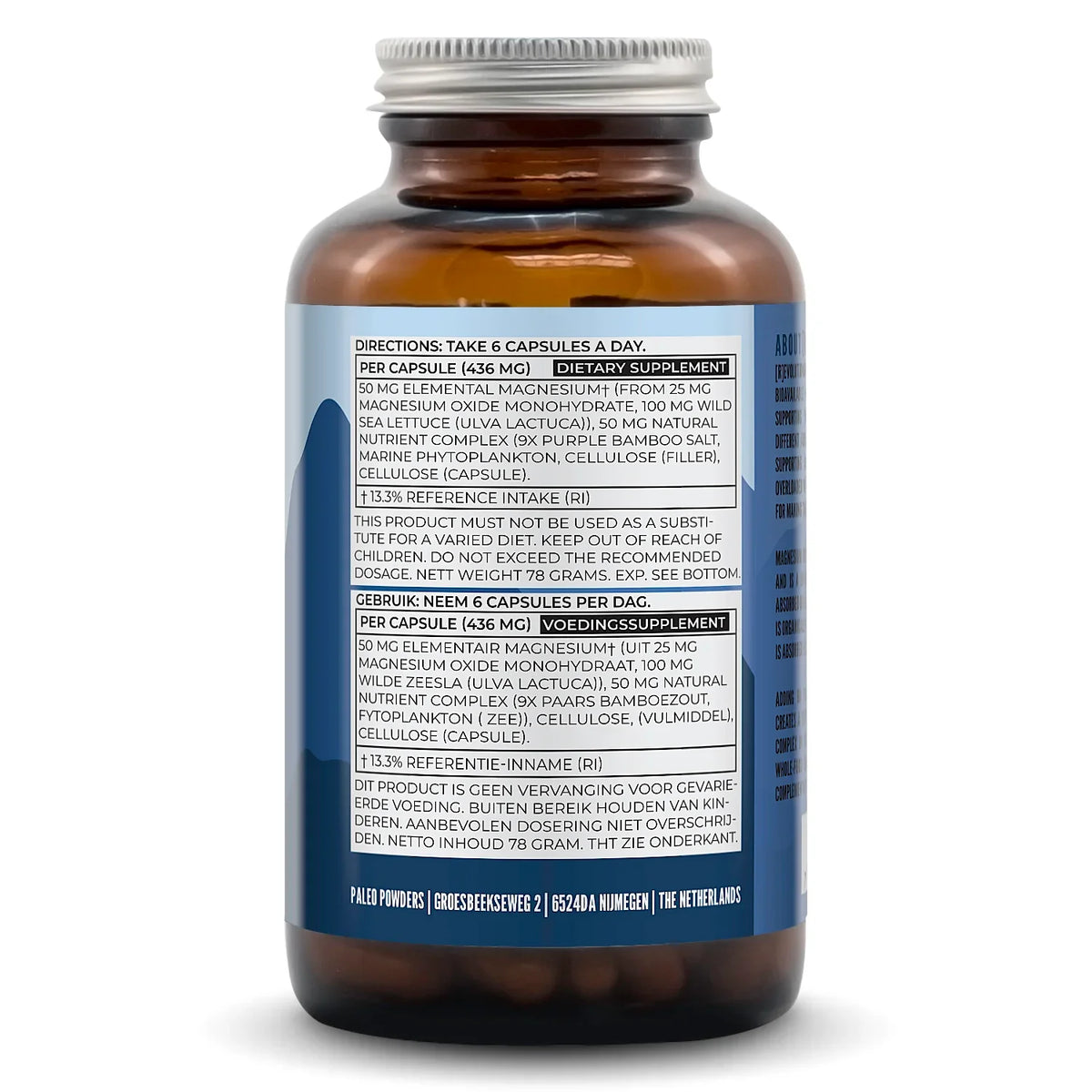
Besides magnesium from the Dead Sea, the formula contains wild sea lettuce (Ulva lactuca), a green seaweed that also grows along the Dutch coast, phytoplankton and Korean bamboo salt. That salt is packed into bamboo tubes and roasted nine times, a tradition from Korea.
How much do you take?
Each capsule contains 50 mg of magnesium, 13% of the reference intake. The manufacturer recommends up to six capsules a day. The EFSA uses an upper limit of 250 mg per day for magnesium from supplements, because more can loosen the stools; with five capsules you stay below that.
Magnesium from the Dead Sea, natural and easily absorbed
Magnesium Oxide Monohydrate is a potent and natural form of magnesium that is sourced from the exceptionally mineral-rich waters of the Dead Sea, one of the oldest and most concentrated salt lakes in the world. This region is known for its unique geological properties and has been valued for its therapeutic potential for thousands of years. Magnesium from this source is carefully extracted and processed into a supplement that is not only pure, but also highly effective. Compared to many other forms of magnesium, such as magnesium citrate or magnesium oxide without the water component, magnesium oxide monohydrate offers a significantly higher bioavailability. Studies show that it is absorbed by the body's cells up to 2.7 times better than many common forms. This makes it an extremely suitable choice for people who want to optimize their magnesium status in a targeted manner.
The power of water
Standard magnesium oxide often has a reputation for being poorly absorbed in supplement form. Magnesium oxide monohydrate is an important exception to this, thanks to its unique molecular structure. It contains an additional water molecule (H₂O), which is essential for the binding and absorption of magnesium in the body. This property ties in with the natural, hydrophilic nature of magnesium, which functions best in a moist, well-hydrated environment, just like in our body cells. This molecular addition makes magnesium oxide monohydrate biologically more active and efficient in transport to the tissues where it is needed. This means that a lower dosage can already be effective, if administered in the right form and combination.
An advanced formula with natural synergy
While many standard magnesium supplements consist of just one form of magnesium or synthetic blends, this formula stands out by combining two powerful, natural sources: magnesium oxide monohydrate and magnesium derived from wild sea lettuce (Ulva lactuca). This natural combination provides both a rapid and sustained release into the body, resulting in stable magnesium levels throughout the day. Additionally, the formula contains a phytoplankton complex and traditional Korean 9x roasted bamboo salt, both rich in additional micronutrients and minerals. These ingredients were carefully selected for their synergistic effects, allowing the supplement to further support the natural absorption and effectiveness of magnesium.
Why this magnesium formula is unique
Contains magnesium oxide monohydrate from the Dead Sea, a rare, pure and easily absorbable form of magnesium. Enriched with magnesium from wild sea lettuce (Ulva lactuca) for long-term bioavailability. Dual source: fast and delayed release for optimal distribution of magnesium absorption. Supplemented with a phytoplankton complex and Korean 9x purple bamboo salt, rich in natural cofactors. Formulated in 50 mg dosable capsules each, easy to adapt to personal needs. No fillers, excipients or synthetic additives. Free from GMOs, gluten, soy, artificial colors or flavors.
The essential function of magnesium in the body
Magnesium is involved in over 300 enzyme reactions and influences almost every organ system. It supports the nervous system, muscle function, energy metabolism, protein synthesis, and the maintenance of normal bones and teeth. In addition, it plays an important role in electrolyte balance and mental functioning. Despite these crucial functions, magnesium deficiency is relatively common. Factors such as stress, intensive sports, medication use, and a magnesium-poor soil result in the need being greater than the daily intake. Supplementation with a well-absorbable form of magnesium can then provide a solution, certainly when combined with other natural cofactors.
Magnesium intake through diet, more difficult than it seems
The recommended daily intake for adults is between 320 mg (women) and 420 mg (men) per day. Foods such as leafy greens, legumes, and nuts contain magnesium, but often in limited amounts per serving. Due to soil depletion and modern agricultural techniques, the magnesium content of food has declined sharply in recent decades. Cooking leads to additional losses: up to 80% of magnesium can be lost during preparation. Drinking water used to contribute to magnesium intake, but is now heavily filtered and softened, resulting in less magnesium from this source. A combination of lower intake and increased need makes supplementation a practical way to maintain magnesium balance. After absorption, magnesium is distributed to bone tissue (53%), muscle (27%) and other body cells (19%). Only a small percentage (about 1%) is found in the blood, which makes monitoring it complex.
Did you know? Fascinating magnesium facts
Magnesium influences over 3,751 proteins and enzyme processes, far more than the often-quoted 300. It plays a key role in DNA replication, RNA synthesis and protein assembly. Magnesium is essential for energy production in mitochondria, the 'power plants' of our cells. It is the fourth most abundant mineral in the human body and crucial for intracellular balance. Magnesium cations also regulate other minerals such as calcium, potassium and sodium within the cell. An adult body contains an average of 25 to 30 grams of magnesium, mostly stored in bones and tissues. Seawater is naturally high in magnesium, one reason why the Dead Sea is a rich source.


