



What the acetyl group changes
Acetyl-L-carnitine is carnitine with an acetyl group attached. That group makes the molecule less polar than plain L-carnitine. In the body the two forms are interconvertible, so these capsules supply both.
Why 500 mg per capsule
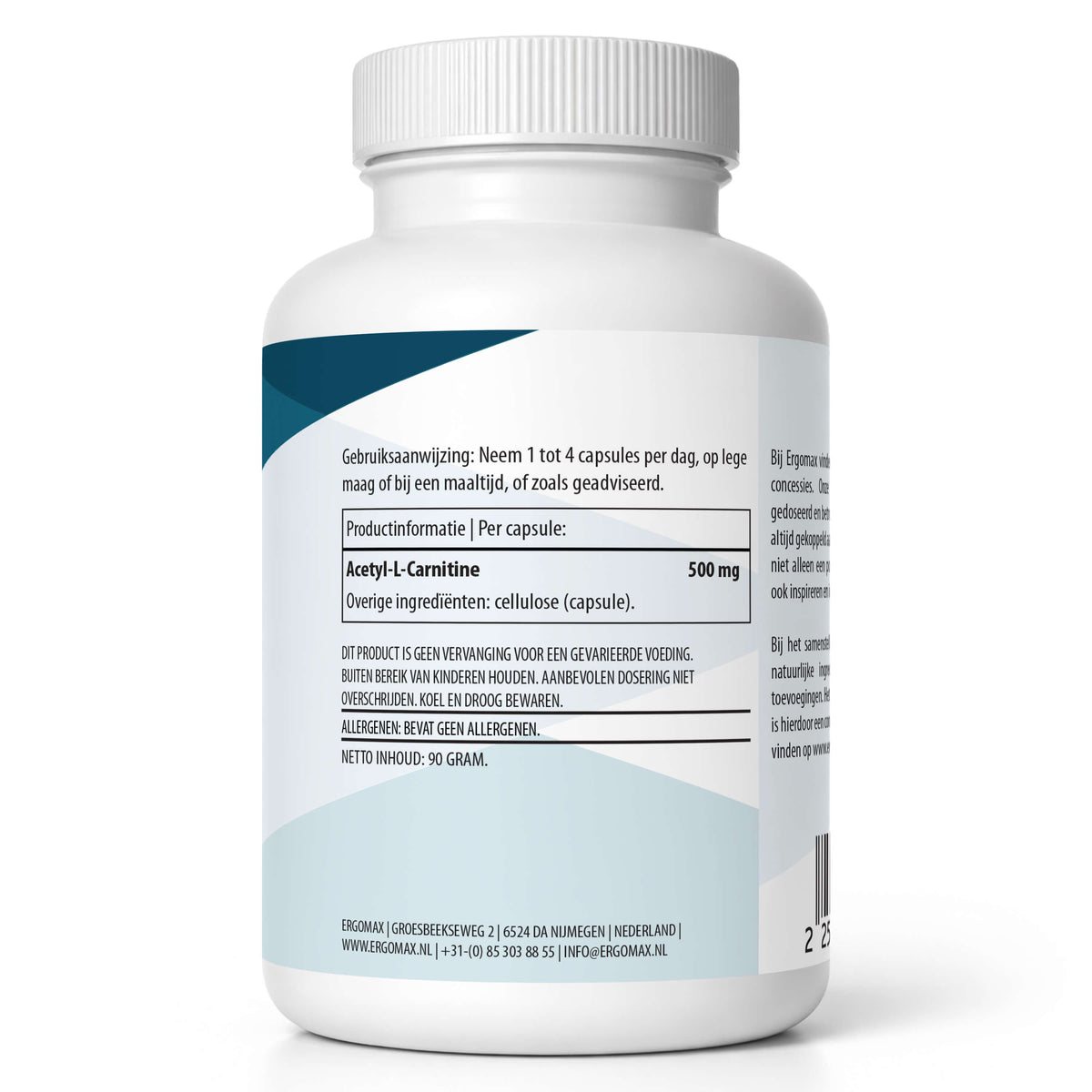
The directions are based on 1500 to 3000 mg per day, spread over three moments between meals. At 500 mg per capsule that comes down to three to six capsules. A jar of 180 capsules is therefore enough for 30 to 60 days.
Precursors and cofactors
Carnitine is a semi-essential amino acid: the body makes it itself, provided the building blocks are there. The precursors are the essential amino acids lysine and methionine, and vitamin C, B3, B6 and iron are needed as cofactors. In older literature carnitine also appears under the name vitamin Bt.
Acetyl groups in the cell
In the cell the acetyl-L-carnitine molecule splits into two parts: L-carnitine and acetyl groups. Those acetyl groups are small carbon units that serve as building blocks in cellular metabolism, among other things in the formation of the neurotransmitter acetylcholine.
Acetyl-L-Carnitine by Ergomax
There are different forms of the amino acid L-carnitine. Acetyl-L-carnitine (also called ALCAR) is the acetylated form. L-carnitine plays an important role in the energy metabolism of bodily cells. L-carnitine is also known as vitamin Bt. It occurs naturally in our body. However, as we age, acetyl-L-carnitine levels drop.
Benefits
- Acetyl-L-carnitine is better absorbed than L-carnitine
- Provides L-carnitine and acetyl groups
- 500 mg of pure acetyl-L-carnitine per capsule
- Athletes, the elderly, vegetarians often choose acetyl-L-carnitine
- Does not contain allergens such as gluten, casein, fish, shellfish, tree nuts, peanuts or soy
- Suitable for vegans and vegetarians
- No artificial colors, flavors or preservatives
Why is acetyl-L-carnitine supplementation eligible?
L-carnitine is a semi-essential amino acid. Our own body can synthesize small amounts, provided that the precursors (two essential amino acids, lysine and methionine) and the required cofactors (vitamins C, B3, B6 and iron) are available. L-carnitine can then be converted, as needed, into acetyl-L-carnitine, and vice versa. For the synthesis of acetyl-L-carnitine we depend on food sources such as red meat and dairy products. Either an adequate supply of these nutrients, or supplementation with acetyl-L-carnitine, is thus required.
L-carnitine and acetyl groups
Within the body, in the cells more specifically, acetyl-L-carnitine molecules are split into two components: L-carnitine molecules and acetyl groups. L-carnitine molecules contribute to an efficient energy metabolism inside our cells. Acetyl-L-carnitine therefore functions as a donor of acetyl groups in the cell. Acetyl groups are essential for many cellular functions. For example, they play a key role in various metabolic processes and the production of neurotransmitters, including acetylcholine. Acetylcholine is the main neurotransmitter involved in memory and thought processes.
Very versatile
Acetyl-L-carnitine is therefore an essential supplement for many important processes throughout the body. Supplementation with acetyl-L-carnitine ensures that the body's needs are covered and that L-carnitine does not first have to be converted into acetyl-L-carnitine. The effective and fast absorption, in combination with the action of both molecules, ensures that acetyl-L-carnitine can be widely used. Acetyl-L-carnitine supplementation may be particularly suitable for the elderly, individuals with increased or specific needs, athletes, vegans and vegetarians.


