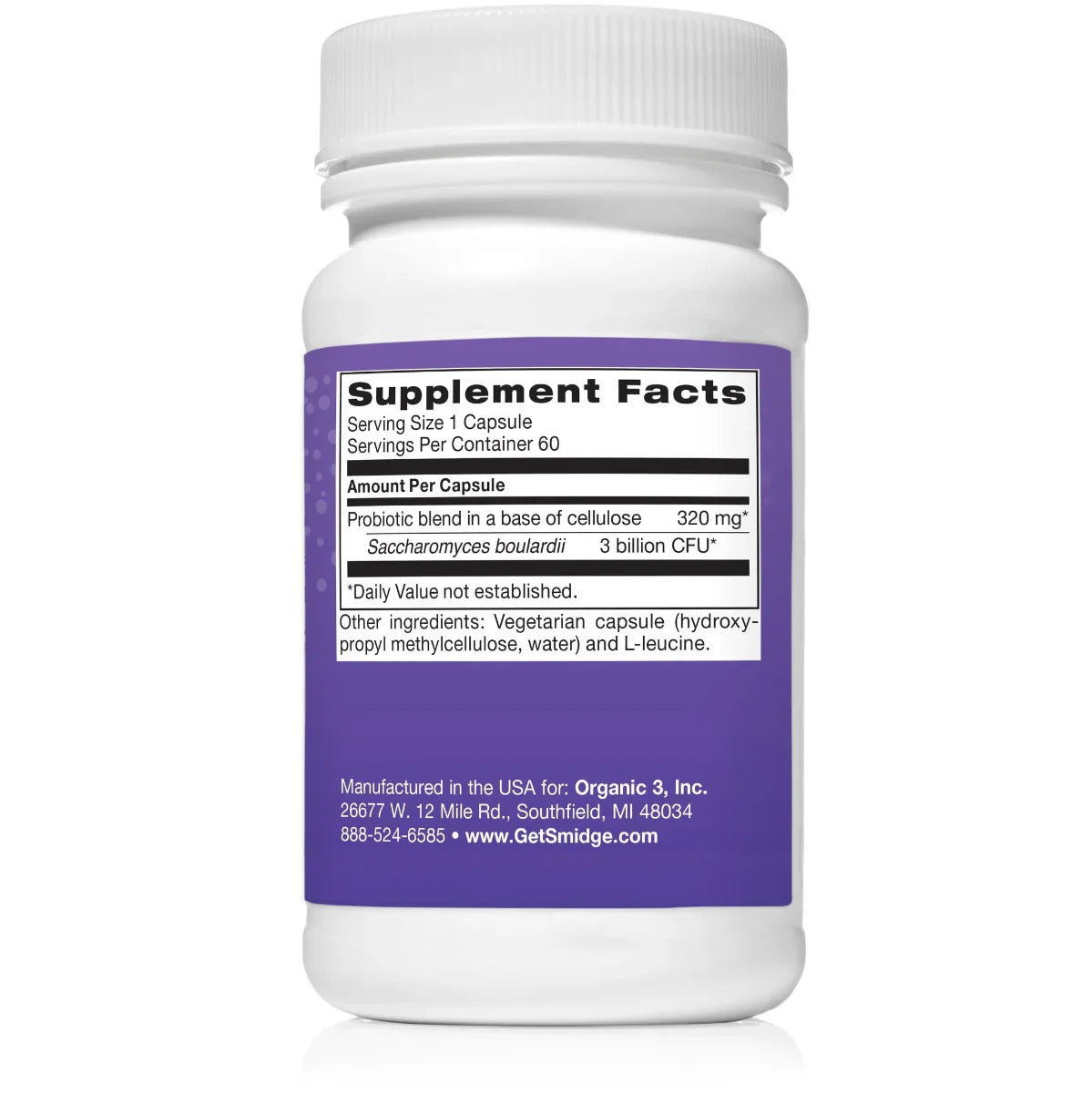
YeastBiotic Saccharomyces boulardii, 60 capsules.

★★★★★ 5.0 · 4 reviews

3 billion CFU Saccharomyces boulardii per capsule, a probiotic yeast that is not affected by antibiotics. No additives other than cellulose and L-leucine.

Why this product?

3 billion CFU Saccharomyces boulardii per capsule

A yeast, not a bacterium, not sensitive to antibiotics

Only cellulose and L-leucine, without prebiotics or other additives

Free from gluten, lactose and dairy, in a plant-based capsule

Freeze-dried, store refrigerated, two capsules per day

Regular price €62,95
Regular price Sale price €62,95
Sale Sold out
60 capsules · 2 capsules per day · €2.10 per day
Taxes included.
Quantity

In stock

Order before 22:00, processed the same day

Free shipping from €85.00 (NL, BE, DE)

Dutch customer service, free advice

View full details
YeastBiotic - Probiotics- 60 capsules

YeastBiotic Saccharomyces boulardii, 60 capsules.

Order before 22:00, processed the same day
Free shipping from €85.00
Money-back guarantee
€62,95
€2,09 per serving
Quantity
01 / The story

A probiotic yeast, from the peel of tropical fruit.

01, The story
02, Form & figures
03, Ingredients & dosage
04, What we may claim
05, Quality & production
06, Frequently asked questions
Reading time · 7 min

YeastBiotic from Smidge contains Saccharomyces boulardii, a yeast with probiotic properties. Each capsule contains 3 billion organisms, with no additives other than cellulose and L-leucine. You take two capsules a day with a meal and keep them refrigerated.

Discovered in 1923

In 1923, the French researcher Henri Boulard travelled through Indochina. He saw that the local population chewed the peel of lychee and mangosteen for intestinal complaints, and he isolated a yeast from that peel. Since then, the yeast has borne his name: Saccharomyces boulardii.

A yeast, not a bacterium

Most probiotics contain bacteria. Saccharomyces boulardii is a yeast, related to baker's and brewer's yeast. Antibiotics act against bacteria and therefore do not affect this yeast. It also tolerates heat and stomach acid.

Use and storage

Take one capsule twice daily with a meal, or as prescribed by a doctor. The yeast is freeze-dried and stays alive best if you keep the capsules refrigerated.

Smidge YeastBiotic capsules

Saccharomyces boulardii is a non-pathogenic and non-colonising yeast with probiotic properties. Since it is not a bacterium, it can be used in conjunction with antibiotics and still survive. The probiotic fungus was discovered in Indochina in 1923. Smidge YeastBiotic capsules contain 3 billion organisms per capsule and, except for the cellulose and L-leucine needed for the encapsulation, include no other additives.

Introduction of Smidge YeastBiotic

Smidge YeastBiotic capsules is a supplement containing the particular yeast species Saccharomyces boulardii, which is both acid-resistant and temperature-tolerant. The yeast is originally a tropical species that was first isolated from the lychee and mangosteen in 1923 by the French scientist Henri Boulard. Boulard had discovered that indigenous peoples there traditionally use the peel of various tropical fruits as an anti-diarrhoeal remedy, and he continued research into this. Saccharomyces boulardii has now been used for over sixty years, and three major studies have been conducted in Europe on the effects of Saccharomyces boulardii on diarrhoea resulting from antibiotic treatments. In the intestines, this yeast produces lactic acid, butyric acid and B vitamins, among other compounds. The supplement is free from dairy, gluten and other common allergens and should be stored in a cool place.

About the intestinal flora

Our intestinal flora is a very complex ecosystem, about as unique as our fingerprint! In our intestinal flora, also called the microbiome, essential substances are produced, including vitamins and neurotransmitters. The microbiome also plays a key role in the digestion of food and in the proper absorption of vitamins, minerals and other nutrients. The microbiome is therefore an extremely important ecosystem in our body. For all these processes to run smoothly, the body works together with the microbes present in the intestines, including bacteria. These intestinal bacteria can be divided into desirable and less desirable bacteria, and into passing species and permanent residents. A normal intestinal flora is in balance.

How do bacteria and enzymes work?

Our intestinal system is populated by billions of microorganisms, each with its own task within the larger whole of our intestinal flora. For digestion to run smoothly, the body works together with these microorganisms. In a normal intestinal flora, these species are in balance with each other, a balance that is different for everyone. Enzymes are able to accelerate all kinds of processes in our body; they are, as it were, the workhorses of our body. Enzymes can sometimes speed up processes as much as a trillion times! In the same way, digestive enzymes act as a kind of catalyst in our intestinal system. They are little chemical factories in our body that we may well cherish.

Benefits

Saccharomyces boulardii is a body-friendly, non-pathogenic and non-colonising yeast with probiotic properties. It contains 3 billion CFUs per capsule. It is antibiotic-resistant and can therefore be taken at the same time as antibiotics. Smidge YeastBiotic capsules contain no gluten, lactose or other common allergens, are free of prebiotics and are freeze-dried. Must be stored refrigerated.

The unravelling of our intestinal flora

We are gaining more and more insight into the workings and important functions of our intestinal flora, but in fact we still know very little about this mysterious organ in our body. The knowledge we have now is probably just the tip of the iceberg! For example, we are slowly beginning to understand the special ways in which bacteria communicate with each other via a mechanism known as quorum sensing. This mechanism allows bacteria, by secreting signal molecules, to be in constant conversation with each other and to attune their behaviour to each other. Among other things, they can tell how many of their own kind are present, and then trigger a synchronised response once a certain number is reached. Friendly bacteria communicate and work together via quorum sensing, a phenomenon that remains as fascinating as it is mysterious to many researchers.

The history of probiotics

Although the term probiotics dates from 1953, the principle is much older. The first traces of the use of probiotics date back to the Neolithic period, between 10,000 and 5,000 BC. Cattle herders in the Middle East at the time kept milk in sacks made from goat skins. Because the sun was shining on it, the milk began to ferment through a combination of lactic acid bacteria and yeasts. The origin of other fermented foods, such as kefir, beer and wine, also dates back to about 7,000 BC. The importance of these sometimes accidental discoveries, however, came to light much later, in the 19th century. In this century, the French chemist and biologist Louis Pasteur developed his theory that the cause of many diseases was a tiny living being, which he called a microorganism. This microbe theory is one of the most important discoveries in medical history and has led to many new insights in the field of microbiology. However, the real science of probiotics in Europe only got going in the 1990s, and since then probiotics have been the subject of countless clinical studies.

Compiled with care

Smidge products are carefully composed in small batches and do not contain unnecessary additives, making them of optimal quality and versatile. Because the products are developed on the basis of the latest insights and because they contain specific neutral bacterial strains, they are well tolerated by almost everyone. The products are therefore also extremely suitable for people with sensitivities or allergies, and they also fit within diets such as the GAPS diet and the paleo diet.

About Smidge

The three founders of Smidge, formerly Organic3, understand that good nutrition is the key to good health. All three have struggled with health complaints in the past and have made it their life's work to guide others towards good health through nutrition. Smidge supplements therefore focus specifically on digestion and the gut, and the formulations are composed with the greatest possible care and without unnecessary additives. The name Smidge means a small quantity, underscoring the fact that they always produce their products in small batches in order to guarantee extra quality. This makes the products suitable for the most sensitive of users and achieves the best possible result. In putting together their unique product line, the work of Dr Weston A. Price and Dr Natasha Campbell-McBride is an important source of inspiration. At Smidge, they have been working together for years on their mission to offer products with essential nutrients that can support the digestive system and help maximise the absorption of nutrient-rich food.

02 / Form & figures

Figures from the label.

As stated by Smidge.

3 bn
CFU per capsule
Saccharomyces boulardii.
1923
Discovered
By Henri Boulard, in Indochina.
2
Capsules per day
With a meal.
30
Servings per jar
60 capsules at two per day.
Ingredients and use

One yeast. Otherwise just the capsule.

Per capsule Amount %RI* Form
Saccharomyces boulardii 3 billion CFU (320 mg)* Freeze-dried yeast
L-leucine Excipient- For encapsulation
Capsule Cellulose, HPMC- Plant-based

* no reference intake established · other ingredients: cellulose, plant-based capsule (hydroxypropyl methylcellulose, water), L-leucine · free from gluten, lactose and dairy, without prebiotics · store refrigerated · dosage: 1 capsule twice daily with a meal · net contents 60 capsules

Product information

How to use it. And everything on the label.

How to use

Take one capsule twice daily with meals or as directed by a physician.

Contents
60 capsules
Allergens
None
Other ingredients
Cellulose, vegetable capsule (hydroxypropyl methylcellulose, water), L-leucine
Storage
Store in a cool, dry and dark place.
Do not exceed the recommended daily dose.
Food supplements should not be used as a substitute for a varied and balanced diet and a healthy lifestyle.
Keep out of the reach of young children.
* RI = reference intake according to European standards.

Reviews · 5.0 / 5 4

What we may claim

EFSA claims for probiotic yeasts.

Framework
EU 432/2012
EFSA register
Subject
Saccharomyces boulardii
(probiotic yeast)

In Europe, we may only make health claims about food supplements that have been assessed and authorised by the EFSA and are listed in the official EU register. That brands outside Europe go further in what they promise is their framework, not ours.

No health claims are authorised in Europe for Saccharomyces boulardii or for probiotics in general. That is why we make no claim for this product.

No authorised claims
EU register
Regulation 1924/2006

There is no authorised health claim for probiotics.

On this page you can read what is in it, where the strains come from and how to use and store the product. What is said about this is not an authorised health claim.

Framework: Regulation (EC) No 1924/2006 and Regulation (EU) No 432/2012. No health claim for probiotic strains is included in the EU register.

Professionally reviewed

Read and checked by a fellow professional.

Diederik Jansen

Independent researcher · editorial review

The content of this page has been checked for factual accuracy, from the composition to compliance with the European rules on health claims. Do not use live yeasts if you have a severely weakened immune system, a central line or catheter, or a serious illness without consulting your doctor. Also consult your doctor if you are pregnant, breastfeeding or have a yeast allergy. This product does not replace medical treatment.

The content of this page has been checked for factual accuracy, from the composition to compliance with the European rules on health claims. Do not use live yeasts if you have a severely weakened immune system, a central line or catheter, or a serious illness without consulting your doctor. Also consult your doctor if you are pregnant, breastfeeding or have a yeast allergy. This product does not replace medical treatment.

Curator's note
A probiotic yeast, discovered in the peel of tropical fruit.
Selected by Ergomax

Most probiotics contain bacteria. YeastBiotic contains a yeast, Saccharomyces boulardii, which Henri Boulard discovered in 1923 in the peel of lychee and mangosteen.

Because it is a yeast, it is not affected by antibiotics. Apart from that, the capsules contain only cellulose and L-leucine.

About the brand

Smidge, briefly explained.

Smidge

Small batches, without unnecessary additives.

Smidge, formerly Organic3, was founded by three people who had dealt with health complaints themselves. The brand focuses on digestion and the gut, with probiotics, enzymes and minerals. The name means a small amount: Smidge produces in small batches, without unnecessary additives. The work of Weston A. Price and Natasha Campbell-McBride is an important source of inspiration.

All products from Smidge
Quality and production

Small batches, no unnecessary additives.

Smidge produces in small batches in order to monitor quality. The formulas contain no unnecessary additives and are designed for people with sensitive digestion. They fit within diets such as the GAPS diet and the paleo diet.

Production 01
Small batches
For quality control
Composition 02
No additives
For sensitive users
Diets 03
GAPS and paleo
Suitable within these diets
Brand 04
Formerly Organic3
Same formulas, new name
08 / Frequently asked questions

What you still wanted to know.

A tropical yeast species that the French researcher Henri Boulard isolated in 1923 from the peel of lychee and mangosteen. It is a non-pathogenic yeast that can withstand heat and stomach acid.

Antibiotics act against bacteria, not against yeasts. Saccharomyces boulardii is therefore not affected by them. Always consult your doctor during a course of treatment, though.

Refrigerated. The yeast is freeze-dried and stays alive best in the fridge.

If you have a severely weakened immune system, a central line or catheter, or are seriously ill, do not use live yeasts without consulting your doctor. Also consult your doctor if you are pregnant or breastfeeding.

Can't find your question? We're happy to help.
Call customer service →
Combines well with

Combining a yeast with bacterial cultures.

People who use a probiotic yeast often also choose a product with bacterial strains. This is a frequently chosen combination, not a set of separate upsells.

YeastBiotic probiotic capsules supplement in its packaging
YeastBiotic · 60 capsules
Sensitive Probiotic Capsules - Smidge™ (formerly GutPro Capsules)
Sensitive Probiotics · 60 capsules
The Smidge routine

YeastBiotic and Sensitive Probiotics, together.

  • 3 billion CFU Saccharomyces boulardii per capsule
  • 10 billion CFU from eight strains per daily dose
Both list a product property, because no claim is authorised for probiotics.
€117,90

YeastBiotic · 60 capsules €62,95 + Sensitive Probiotics · 60 capsules €54,95

Or add individually
Smidge

Digestive enzymes · 120 capsules

Ten enzymes from Smidge, with a meal.

€49,95
Prescript Assist

Prescript Assist · 60 capsules

Soil-based bacteria with leonardite, keeps at room temperature.

€59,95