
Assess your thyroid and take the self-test
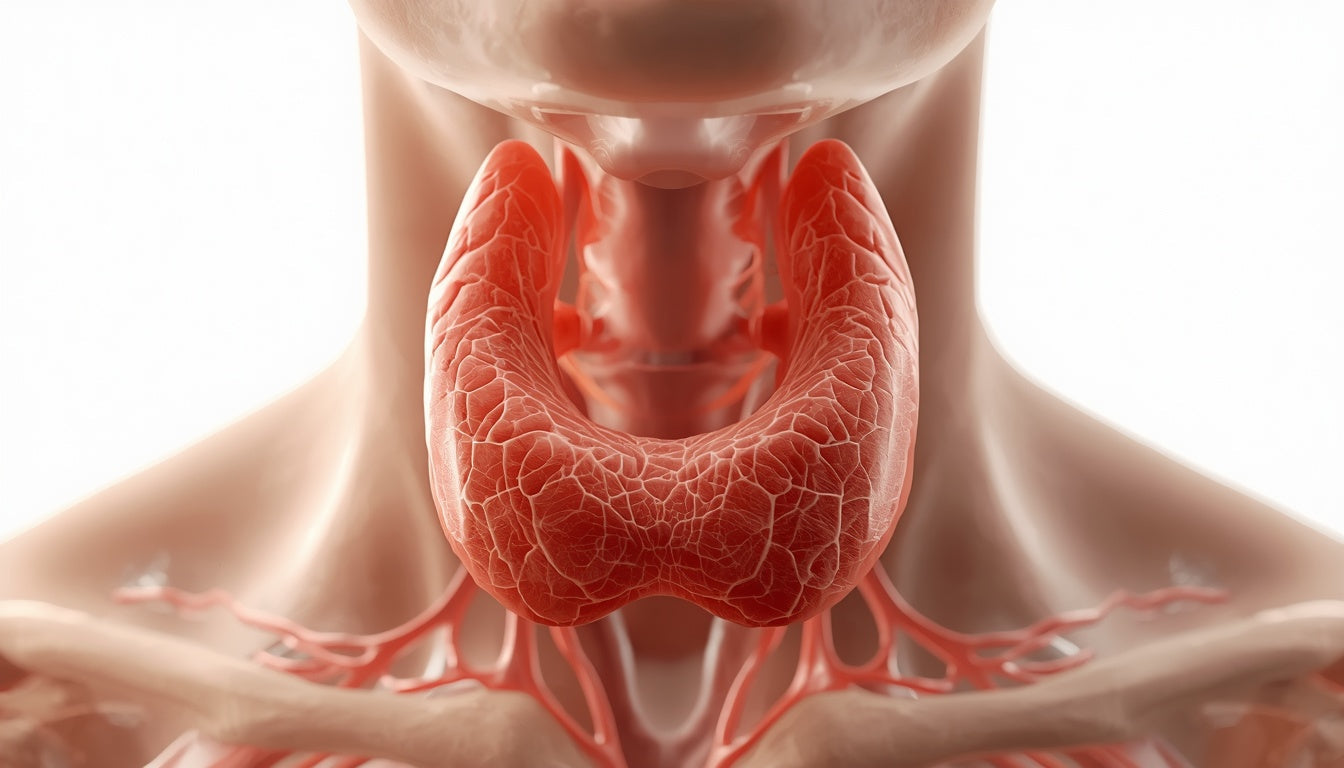
The thyroid is a butterfly-shaped gland located in the neck, in front of the trachea. It is the most highly perfused organ in our body and receives blood from as many as four arteries. Not without reason: the thyroid is responsible for distributing the hormones that regulate metabolism. These hormones affect every function in your body.
The three hormones produced in the thyroid are:
- Triiodothyronine (T3)
- Thyroxine (T4)
- Diiodothyronine (T2)
Almost 90% of the hormone produced by the thyroid is T4 (inactive form). In the liver, T4 is then converted into T3 (active form). T2 is less active than T4 and T3, and it is also the form we know the least about.
These hormones interact with all other hormones produced by the body, including insulin, cortisol, testosterone and estrogen. The fact that all these hormones function in a system and constantly communicate with each other explains why a well-functioning thyroid is so important.
A small organ with important functions
The hormone system should therefore be approached from a holistic perspective. The thyroid can thus be seen as an integral part of a system of different glands that produce hormones.
Leptin hormone as conductor
Ultimately, however, the hormone leptin is the master hormone. Leptin is at the top of the hormone hierarchy: it is a conductor that directs an entire orchestra of hormones so that a harmonious whole is created.
Test your thyroid yourself in 2 ways
Just as there are many aspects that influence thyroid function, there are also many signs when it is not functioning optimally. The following two simple home tests can be used to assess the thyroid easily. Note: this self-assessment is not intended as a replacement for clinical evaluations.
The paper test
Professor R. Ross, an endocrinologist affiliated with the University of Sheffield, states that trembling hands can be a sign of an overactive thyroid. Women between 20 and 40 are ten times more susceptible to this than men.
To perform the test, hold your hand out in front of you with the palm facing down. Place an A4 sheet on top of your hand. A visible wobble of the sheet may be a positive indication.
The ankle-tap test
Professor P. Bouloux, an endocrinologist affiliated with the Royal Free Hampstead NHS Trust in London, states that an overall slow metabolism, and therefore also slow reflexes, can be a sign of an underactive thyroid.
To perform the test, cross your legs so that one calf rests on a knee. Extend your foot slightly and locate the Achilles tendon. Use a spoon to tap the tendon firmly. The ankle should respond with an immediate reflex. If the response is slow, or if the ankle slowly returns to its original position, this may be a positive indication.