



What DP2 to DP6 means
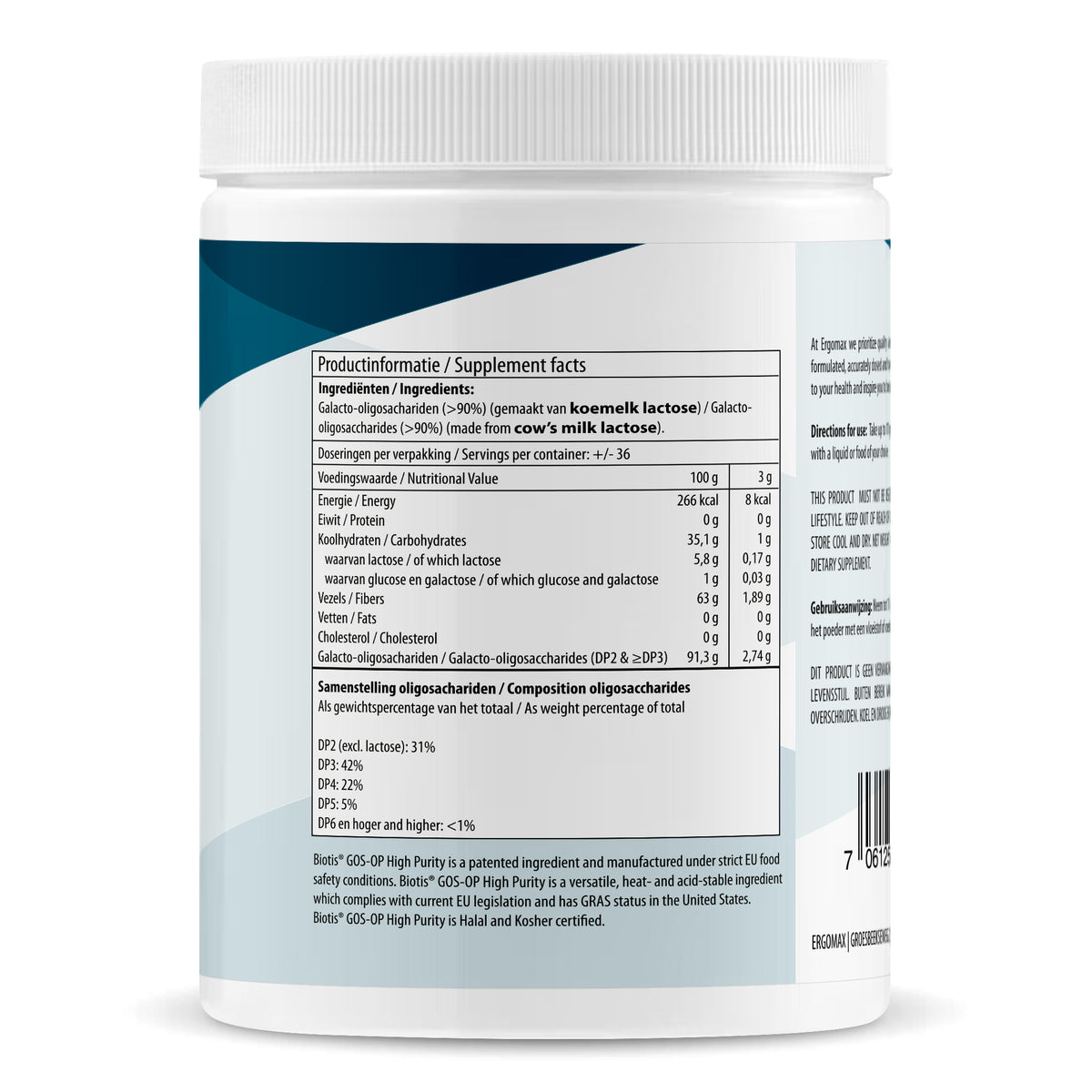
DP stands for degree of polymerisation, the number of sugar units in a chain. This powder is not a uniform substance but a distribution: 31 percent DP2, 42 percent DP3, 22 percent DP4, 5 percent DP5 and less than 1 percent DP6 and longer. That spread determines how the fibre behaves.
Why purity matters
With GOS, the purity percentage tells you how much of it is actually fibre after the conversion and how much ordinary sugar is still in it. This raw material is above ninety percent. What remains is limited: 0.64 grams of lactose and 0.11 grams of glucose and galactose per 11-gram serving.
Biotis GOS-OP High Purity
The raw material used is Biotis GOS-OP High Purity, a patented ingredient produced under European food safety rules. It is heat and acid stable, has US GRAS status and is halal and kosher certified.
What happens to it in the gut
Prebiotic fibres are not digested in the small intestine and arrive unchanged in the large intestine. There they are fermented by bacteria, producing short-chain fatty acids such as butyrate, acetate and propionate, as well as gases such as hydrogen and carbon dioxide.
GOS Prebiotics, Biotis® GOS 400 grams
Biotis® GOS High Purity is a high-quality galacto-oligosaccharide (GOS) of Dutch origin, produced by FrieslandCampina. Galacto-oligosaccharides are among the most extensively researched prebiotic fibers and consist of short chains of galactose units derived from lactose. GOS occurs naturally in human breast milk as part of the broader family of oligosaccharides.
Biotis® GOS is produced according to high-quality standards and is known for its excellent solubility, neutral taste, and versatile applications. The powder is easy to mix with water, yogurt, smoothies, and other foods. Thanks to its mild, slightly sweet taste, it can also be easily combined with other supplements and functional ingredients.
Why Choose Biotis® GOS?
- Produced by FrieslandCampina Ingredients in the Netherlands
- High-quality galacto-oligosaccharides (GOS)
- Mildly sweet, neutral taste
- Excellent solubility in water and other beverages
- Suitable for daily use
- GMO-free
- Soy-free
- No artificial colors, flavors, or fragrances
- Combines well with probiotics and other nutritional ingredients
Dutch Quality and Expertise
Biotis® GOS is developed and produced by FrieslandCampina, part of one of the world’s largest dairy cooperatives. The ingredient is manufactured according to strict quality and safety standards and is used worldwide in foods, dietary supplements, and specialized nutrition concepts.
Due to its high purity and consistent quality, Biotis® GOS is a widely used ingredient in innovative nutritional formulations. The powder has excellent processing characteristics, making it suitable for capsules, sachets, powders, and functional food products.
Fermentable Dietary Fiber
GOS belongs to the group of soluble dietary fibers. These fibers are not broken down in the upper part of the digestive tract and reach the large intestine largely intact, where they become part of natural fermentation processes. This distinguishes GOS from many other carbohydrates that are digested earlier in the body.
Synbiotic Combination
Biotis® GOS can be excellently combined with probiotic supplements such as Kefir Probiotics and with oligosaccharides such as 2’-Fucosyllactose (2'-FL). The combination of prebiotics and probiotics is often referred to as a synbiotic approach and is widely applied in modern nutritional concepts.
The Ultimate Prebiotic
GOS is an excellent prebiotic, alongside other prebiotics such as fructo-oligosaccharides (FOS), xylo-oligosaccharides (XOS), soy oligosaccharides (SOS), and inulin. GOS is exceptionally well tolerated. Prebiotics are also referred to as soluble fibers. There are also insoluble dietary fibers, which are recognized for supporting regular bowel movements.
Hydrogen Is Also Produced
In addition to short-chain fatty acids, fiber consumption also produces gases such as hydrogen and carbon dioxide. Together with oxygen, hydrogen is deeply connected to the origin and evolution of life on Earth. The balance between oxygen and hydrogen as antioxidants, or between oxidation and reduction, is essential in living organisms.


