



Two amino groups instead of one
Almost all amino acids have one amino group. Glutamine has two. That is why the body can build almost every other amino acid from it: the extra nitrogen group is transferable. Of the roughly five hundred known amino acids, twenty-two occur in human proteins, and glutamine is the most versatile building block among them.
What glutamine does in the cell
In the cell, glutamine serves among other things as a precursor of glutathione and of nucleotides, and as an energy substrate. Our body consists of about twenty percent protein, and within it amino acids play a role in cell metabolism and in communication between cells.
Fermentation at Kyowa
The raw material comes from the Japanese company Kyowa and is made through a natural fermentation process. No synthetic additives, solvents or animal materials are used. The purity meets the pharmaceutical standard, and for a powder that you dose in grams that is no unnecessary luxury.
Building up gradually
In powder form, glutamine is dosed higher than most supplements. Therefore build up the amount gradually so that the body can get used to it, and reduce it again if it causes you discomfort. If you are considering a higher dosage, it is wise to agree on this with a doctor or therapist.
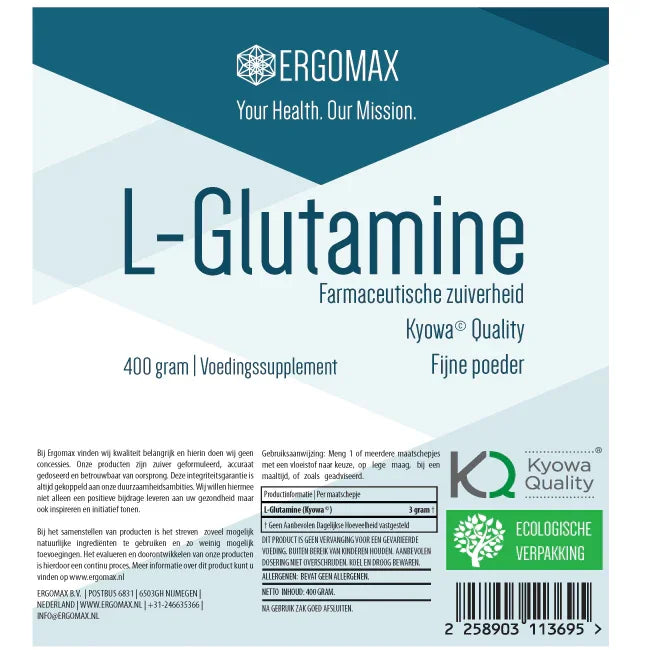
L-Glutamine powder Kyowa® by Ergomax
L-Glutamine is a real all-rounder among the amino acids and is therefore appropriately called 'the ultimate nutrient'. It is the most abundant free amino acid in the human body, and it is involved in more metabolic processes than any other amino acid. Athletes and people for whom supplementation is of general significance often opt for L-glutamine.
Benefits
- Widely usable due to the inclusive range of effects
- Pure pharmaceutical grade L-glutamine, from Kyowa®
- Free from allergens and GMO
- Suitable for vegans and vegetarians
Pharmaceutical quality
Ergomax's L-glutamine is a pharmaceutical-grade Kyowa Quality® product. Glutamine from the Japanese producer Kyowa is produced through a natural fermentation process. No synthetic additives, solvents or animal materials are used. Purity is an important factor in the quality of any dietary supplement. The purity of our L-glutamine is exceptionally high and meets the pharmaceutical standard. This allows our L-glutamine to be taken in an extremely high dose.
Glutamine in the body
Glutamine is a semi-essential, or conditional, amino acid that can become essential in specific situations when one's own body reserves are depleted. Most tissues can synthesize small amounts of glutamine. Most of the glutamine resides within the cells. Diverse biological functions include the role as a precursor to glutathione, as a precursor to nucleotides, and as an energy substrate.
Building blocks of the body
L-glutamine is so essential that almost all other amino acids can be made from L-glutamine. Unlike almost all other amino acids, L-glutamine has two amino groups instead of one. Amino acids are the building blocks of proteins and are therefore crucial for our body. Our body consists of about 20% proteins. Amino acids play a key role in almost all of the body’s biochemical processes, including cell metabolism, as energy metabolites, as essential nutrients and as messengers in cellular communication. Of the five hundred identified amino acids, twenty-two occur in human proteins, the so-called genetically encoded (proteinogenic) amino acids.
L-glutamine as a precursor to almost all amino acids
Amino acids are released from proteins in our diet using enzymes. Specific amino acids can be built up again from the released amino acids. Almost all other amino acids can be built from L-glutamine. The body can therefore synthesize a number of amino acids itself: the non-essential amino acids. The essential amino acids can only be obtained either from food or supplementation. Non-essential amino acids can still become essential in specific situations.
Glutamine protocol: Start slow
It is important to slowly build up the dose of L-glutamine so that the body can get used to it while avoiding possible side effects. Pause or reduce the dose if you experience side effects, then build it up more slowly. Long-term use of glutamine at 14 grams daily is safe, and dosages up to 60 grams per day can be used safely for several consecutive weeks. An end-dose of 20-40 grams per day is often ideal.
- Day 1 & 2: 3 grams in the morning and 3 grams in the evening with dinner
- Day 3 & 4: 6 grams in the morning and 6 grams in the evening with dinner
- Day 5 & 6: 9 grams in the morning and 9 grams in the evening with dinner
- Day 7 & 8: 12 grams in the morning and 12 grams in the evening with dinner
- Day 9 & 10: 15 grams in the morning and 15 grams in the evening with dinner
- Day 11 & 12: 18 grams in the morning and 18 grams in the evening with dinner
- Day 13 & 14: 21 grams in the morning and 21 grams in the evening with dinner


