


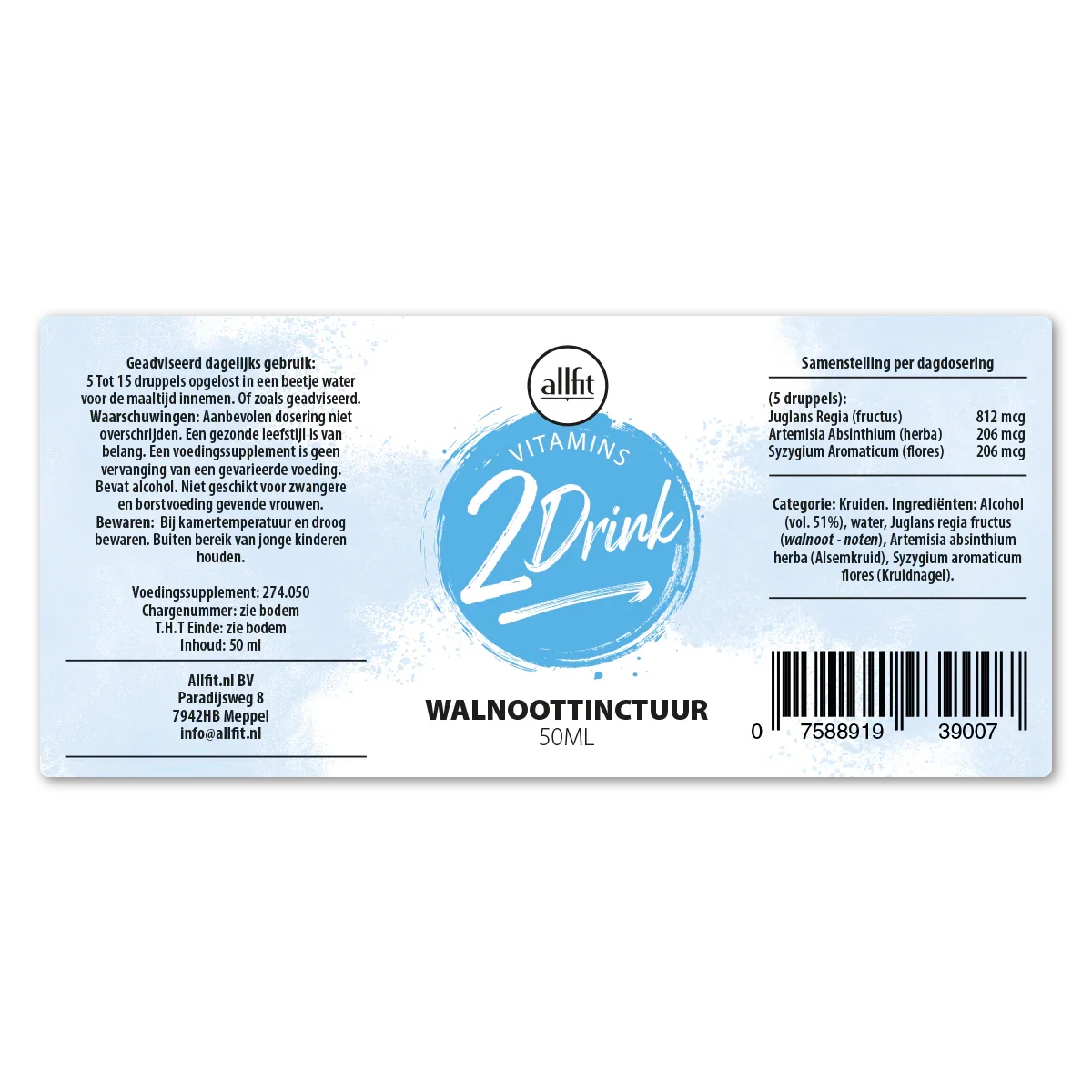

Three herbs, three groups of substances
Walnut contains juglone and tannins, wormwood contains bitter lactones, terpenoids and essential oils, and clove contains eugenol. Because of these substances, these three herbs have been combined in herbal formulas in folk medicine for centuries.
Cold-macerated
With the cold maceration method, the herbs lie in a mixture of alcohol and water for a longer period, without heating. The alcohol content is tailored to each herb, so that the soluble components end up in the tincture as well as possible. The end product contains 51% alcohol.
Wormwood, the bitter herb from absinthe
Wormwood (Artemisia absinthium) is one of the most bitter herbs we know and a classic ingredient in absinthe and other bitters. For the tincture, the aerial parts are used, harvested just before or during flowering.
Black walnut or common walnut?
Walnut tincture has a rich tradition in herbal medicine and has been used for centuries because of its powerful properties. Colloquially, such a tincture is often called black walnut tincture, but this tincture is made from the common walnut or English walnut (Juglans regia) and not from the American black walnut (Juglans nigra). It is prepared from the husk of the unripe fruits, a part that is rich in natural substances such as tannins and juglone. The walnut is known for its characteristic deep colour and distinctive smell, which makes the tincture a striking ingredient in plant-based formulas. Walnut tincture is traditionally valued for its wide range of uses.
Wormwood herb (Artemisia absinthium)
Wormwood is a plant with a distinctly bitter aroma and is also traditionally widely used in tinctures, especially in Europe and Asia. The tincture is made from the aerial parts of the plant, often harvested just before or during flowering. Wormwood is best known as a classic ingredient in absinthe and other bitter elixirs. The silvery-green leaves and strong smell make wormwood a striking herb in both herbalism and folklore.
Clove (Syzygium aromaticum)
Clove is a spice that comes from the dried flower buds of the clove tree. Clove tincture has a powerful, warm smell and a dark brown colour. It is a popular ingredient in traditional herbal formulas and is often valued for its aromatic properties. Because of its intensity, clove is often used in small amounts, but it is an important element in many classic herbal blends, where it adds a warming and spicy note.
Why combine these three herbs?
Walnut contains juglone and tannins. Wormwood contains lactones, terpenoids and essential oils. Clove contains eugenol. These substances work together and have an effect on uninvited guests in the body, or for when there is an imbalance. By adjusting the conditions in the gut, an unfavourable living environment is created. This has an effect on the different stages of their life cycle.
Made with care and purely formulated
The tincture is prepared using the traditional cold maceration method, which preserves a wide range of active substances. The alcohol content is carefully tailored to each herb to ensure an optimal amount of soluble active components. This product is 100% natural: all herbs are grown responsibly.


