
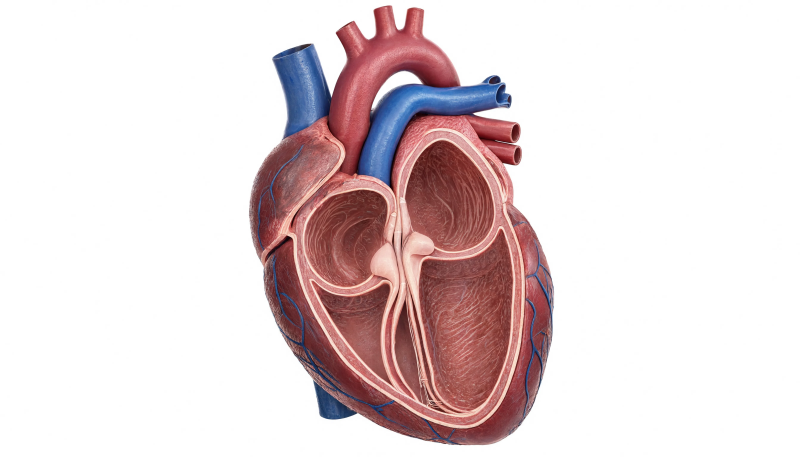
Is the heart really a pump?
If someone were to ask you what the heart is physiologically, you would probably answer 'a pump'. It has become common knowledge that the human heart functions as a pump that pushes blood in and out of the blood vessels. It beats an average of three billion times in a human lifetime, and an 'average' heart can empty a swimming pool within a week. But did you know that there is an interesting alternative theory?
The Heart is a Pump: History
The theory that the heart functions as a pump was, as far as we know, first conceived by Galileo and Leonardo Da Vinci. In their drawings, the heart is depicted as a pressure chamber. However, it was only in the 17th century, with the publication of William Harvey's De Motu Cordis, that the concepts of blood circulation and the heart pumping blood in and out were recorded.
Alternative Views
In 1920, Rudolf Steiner was the first to oppose the heart's pump mechanism and instead suggested that blood flow is propelled by its own biological momentum. Steiner also suggested that pressure is not the cause of blood flow, but the result of it. In 1932, Dr. Bremer filmed blood flow in an embryo that circulated in spiral movements, even before the heart worked!
So is the Heart a Pump?
Let's start by defining what a 'pump' is. A pump is defined as a pressure propulsion device. When scientists in traditional medicine say that the 'heart is a pump', they mean that the walls of the heart generate pressure. But is that even possible?
The alternative view says this cannot be for three main reasons:
First, the heart weighs about 300 grams, while the blood vessels in our body, if you laid them end to end, would circle the Earth at least twice. If the heart were a pump, it would need enormous force to push a sticky fluid like blood through the millions of tubes, such as blood vessels. This is mechanically impossible.
Second, the speed of blood movement is problematic. Blood moves fastest out of the heart, then slows down, comes almost to a standstill, and then increases in speed again before entering the heart. How can a pump regulate this type of speed? There must be another mechanism that moves blood through the blood vessels.
Finally, the function of the aortic arch. The aortic arch is the segment of the heart where blood leaves the heart. If the heart indeed worked as a pump, the speed at which blood leaves the aortic arch should cause it to stretch. Think about what happens when you turn on the tap to a water hose. On the contrary: the aortic arch bends even more when blood leaves the heart, which contradicts the idea of 'pumping blood away'.
So the Heart is not a Pump. What Does the Alternative Theory Say?
It is assumed that blood has no form, is forced to fill the blood vessels, and thereby takes on their shape. But what if blood has a form: that of a vortex or whirlpool. The vortex circulates in the vessels through its spiral movement, and the purpose of the heart is to stimulate the momentum of that movement with spiral stimuli.
With the vortex in mind, the heart functions as a flow organ rather than a pump organ. Blood enters the left ventricle and flows clockwise, to then be stopped by an opposite movement. In other words, the heart works as a brake and reverses the direction of blood movement. By the time blood flows out of the left ventricle, it is moving counterclockwise.
The heart promotes spiral blood flow by contracting the walls. No 'push' is needed: it is a passive filling and distribution system. The blood vessels mimic heart function by expanding to receive incoming blood and contracting to enhance blood flow.
Does the Heart Have Other Functions?
Many are not aware that the heart is also part of the endocrine system. This system is the collection of glands that release hormones and regulate many bodily functions, including growth, metabolism, sleep, mood, sexual function, and tissue function. For example, the heart is responsible for producing hormones known as natriuretic peptides, specifically 'atrial natriuretic factor' (ANF). ANF enhances the excretion of sodium (natriuresis) and water via urine (diuresis).
When the body detects increased blood pressure or increased blood volume, the heart releases these natriuretic peptides. These hormones stimulate receptors in the walls of arteries and relax the muscles of veins and arteries, thereby lowering blood pressure.
Do you think the heart is not a pump, but a 'flow organ' that stimulates the spiral movement of blood? Would this theory ever cause medical books to be rewritten, just like the Wim Hof study that proved the autonomic nervous system can be consciously controlled? The heart is, in any case, not just a muscle, but also a hormone-producing gland. What an amazing organ!