View and compare your stools!
There are many different ways to evaluate your health. For example, you can look at your mood or how well you sleep. Blood, saliva and urine analyses are widely used clinical evaluations.
A good way to analyze your health that you may not think of right away is by looking at your poop. It is an excellent indicator of your digestion. Looking at your poop can provide information about:
• Hydration/Dehydration
• Food sensitivity
• Digestion
• Balance of gut flora
But what is considered normal poop, and how can you draw conclusions by looking at it? The answer is not really black and white. It depends a bit, because everyone is different and each person’s situation varies.
The University of Bristol developed the Stool Scale in 1997, and it can be used as a useful guideline. The “Bristol Stool Scale” was specifically developed so that something could be measured and compared. There are 7 different types of stool: types 1–3 indicate varying degrees of constipation, types 5–7 are considered different forms of diarrhea, and types 4 and 5 are optimal or normal.
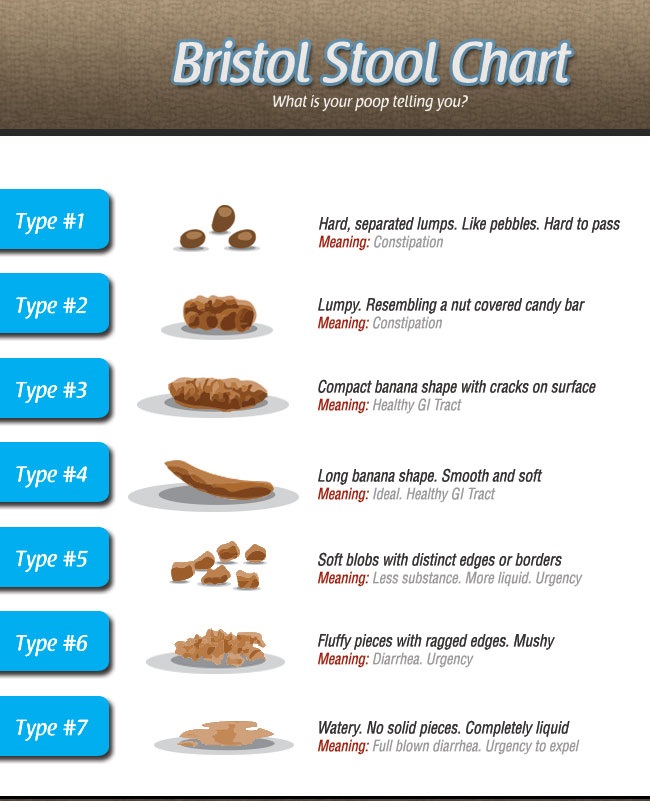 |
Type 1: Separate hard pellets, like nuts (hard to pass) |
What exactly is poop made of?
Human stool varies quite a lot, depending on diet and health. The brown color comes from a combination of bile and bilirubin from dead red blood cells. The smell is caused by gut bacteria that produce sulfur-containing compounds and hydrogen sulfide. 65–85% of normal stool consists of water. The dry weight consists of 30% bacteria, 30% undigested food and fiber, 10–20% fat, 10–20% inorganic material and 2–3% protein.
How should I poop properly?
Simply sitting on the toilet is no longer good enough. Raising your legs so that you are more in a squat position is better. By “opening” the bowel, pooping in this position is faster, you empty better and you need to strain less. This can help prevent hemorrhoids. Simply place a small stool in front of the toilet so that your knees are about as high as your chest.
Not scoring well?
Then improve your poop score with the following tips:
Chew your food well: if food is tough and needs to be chewed thoroughly, it will also be harder to digest if you do not. To digest food optimally, it should be well chewed before swallowing.
Drink enough water: dehydration is one of the most common causes of chronic constipation.
Eat fiber or fats: eat more fiber if you want slower bowel movements. Eat more protein and fats if you want to speed up bowel movements.
Digestive enzymes: these workhorses of the body break down food so it can be absorbed. Without enzymes, you do not get nutrients from food.
Pre- and probiotics: can come from whole food sources or supplements. Beneficial bacteria and indigestible fibers play a crucial role in how the intestines function.